Friday, January 9, 2026
By: Kyle Niblett
A rare winter storm rolls through Gainesville this weekend as faculty, staff and students are away. Freezing temperatures are hypothetically expected, and the water pipes are suspect. A computer, reading this, immediately sends a work order request to facilities saying a pipe is about to burst. Just like that, a potential emergency costing five or six figures is prevented before ever happening. All thanks to the building having a digital twin.
So, what is a digital twin? It is certainly something that did not exist when the college was founded more than a century ago in 1925. A digital twin for a building is a virtual replica of the physical building that integrates real-time data, three-dimensional models, artificial intelligence and operational systems to monitor, simulate, and optimize the building’s performance. It acts as a dynamic mirror of the actual building throughout its lifecycle—from design and construction to operation and maintenance.
The College of Design, Construction and Planning (DCP) has long understood that the future of the built environment lies in how we leverage data and visualization technologies to develop innovative constructed facilities. Our leadership in digital twin technology is a natural evolution of our decades-long commitment to Building Information Modeling (BIM), visual representations and multi-disciplinary collaboration. In fact, over the past seven years, the college has had more than five Ph.D. graduates whose research was focused on aspects of digital twin technology. With technology leaders like NVIDIA, Autodesk, Trimble, and others partnering with DCP, the college isn’t just preparing its students for the future – it’s working to define it.
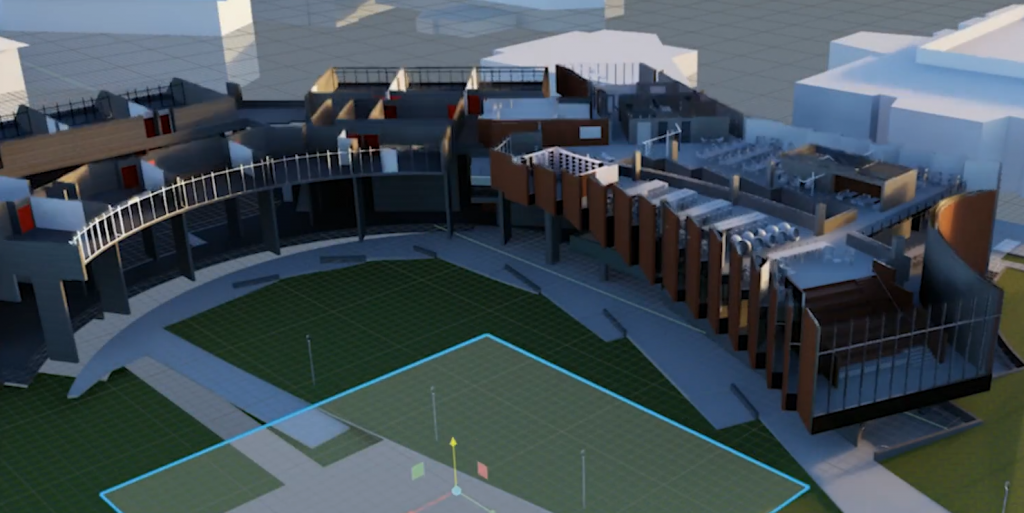
As such, the soon-to-open Bruno E. and Maritza F. Ramos Collaboratory at DCP will make history as the first new-built digital twin building on the campus of the University of Florida. With architecture, engineering and plumbing models all in the digital twin, a 3D overlay of them all will be helpful for environmental conditions, among other things.
“The Ramos Collaboratory marks a new era for the University of Florida—our first newly constructed Digital Twin (DT) facility and a national model for innovation in the built environment,” DCP Dean Chimay Anumba said. “The DT will provide our students, faculty, staff and UF Facilities with new insights into the building’s operation and performance. As a living lab, it offers tremendous research opportunities and reflects DCP’s leadership in smart, sustainable design and construction.”
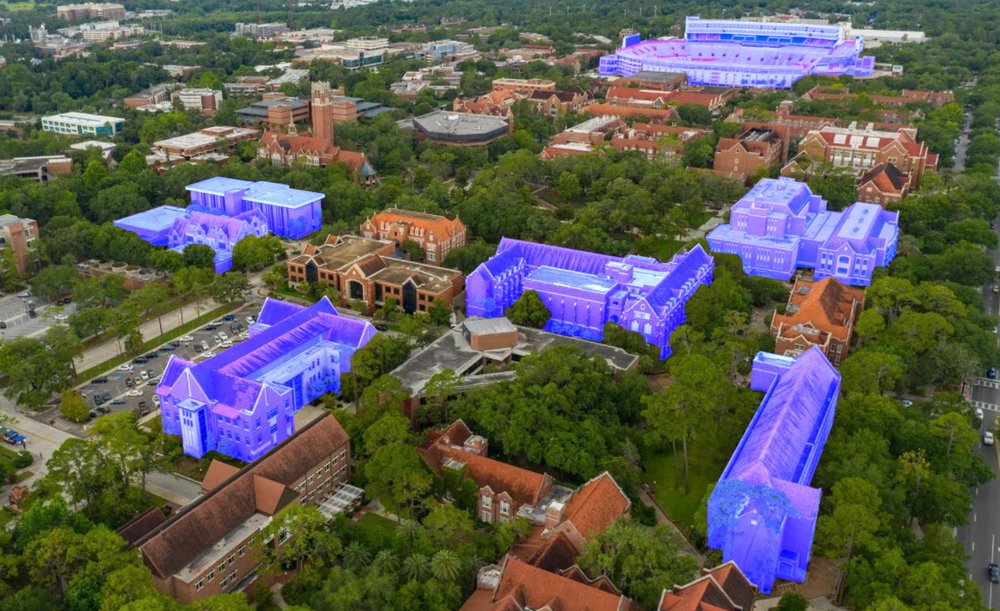
The Ramos Collaboratory might be the first new-built digital twin on campus, but DCP has partnered with others on campus to ensure other buildings are now being updated with digital twins. Dr. Raymond Issa, director of DCP’s Center for Advanced Construction Information Modeling, has led a team of faculty and students to help creating a template for implementing digital twins that can be applied across all UF buildings. An example of this would be Heavener Hall, home of the UF Warrington College of Business, which recently had its digital twin born.
“Our goal is to have a ‘campus verse’ as I call it, where every building at UF has a digital twin,” Issa said. “We want everything to be visually integrated into all facilities, so we have a holistic view of the campus.”
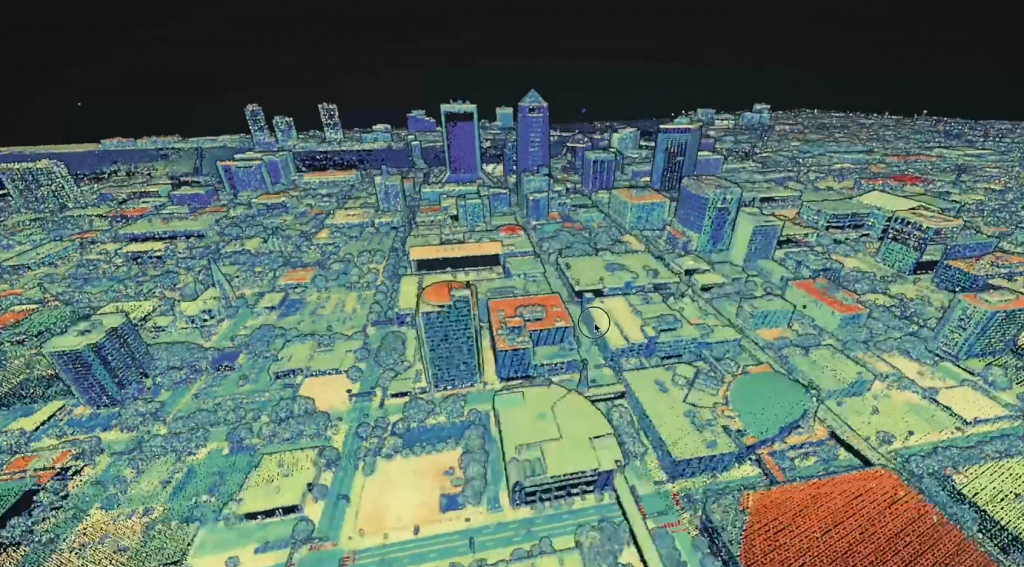
Off campus, DCP faculty such as Dr. Karla Saldaña Ochoa, Jeff Carney and Changjie Chen are helping build digital twins for cities like Jacksonville. The virtual replica of Jacksonville focuses on finding correlation between health, hazards and housing. They have been able to model 32,000 buildings in the city and identify whether a building is going to be at risk for flooding.
“What we’re doing with the project is that we’re creating a data-rich environment where these three features (health, hazards and housing) are populated in the whole city, and then we are testing scenarios,” Ochoa said. “So, we’re testing a scenario saying, what happened if there is four feet of water, because this area has been predicted to be vulnerable to that amount of water? Will it affect the existing infrastructure, in this case, septic tanks, and what will be the head health outcomes that we see right now?”
Looking toward the future, Anumba and the college understand how digital twins represent a transformative leap in how we understand, design, and manage the built environment. They will create much more informed decision-making and consensus making progress and lead to faster decisions. People studying it will all be able to see the same thing at the same time, revolutionizing the way buildings are viewed and worked on.
“Digital twins enable us to bridge the gap between the digital and physical worlds in ways not previously possible, and offer an unparalleled platform for experiential learning, multi-disciplinary research, and data-driven decision-making,” Anumba said. “At DCP, we see digital twins as critical systems for enhancing our students’ capacity to visualize, simulate, design, construct, and improve the operational efficiency of the spaces and facilities we create.”