Monday, December 22, 2025
University of Florida Department of Interior Design Associate Professor Shabboo Valipoor, Ph.D., spent two weeks in Detmold, Germany, this November deepening research and teaching collaborations with the OWL University of Applied Sciences and Arts – Technische Hochschule Ostwestfalen-Lippe (TH OWL), a long-term partner of UF’s College of Design, Construction and Planning (DCP). The college has had an established exchange program with TH OWL’s Detmold School of Design, where UF students participate in summer programs and TH OWL students take courses at UF in the fall semester.
Keynote in the “Dienstagsvorträge” Series: Design for Aging
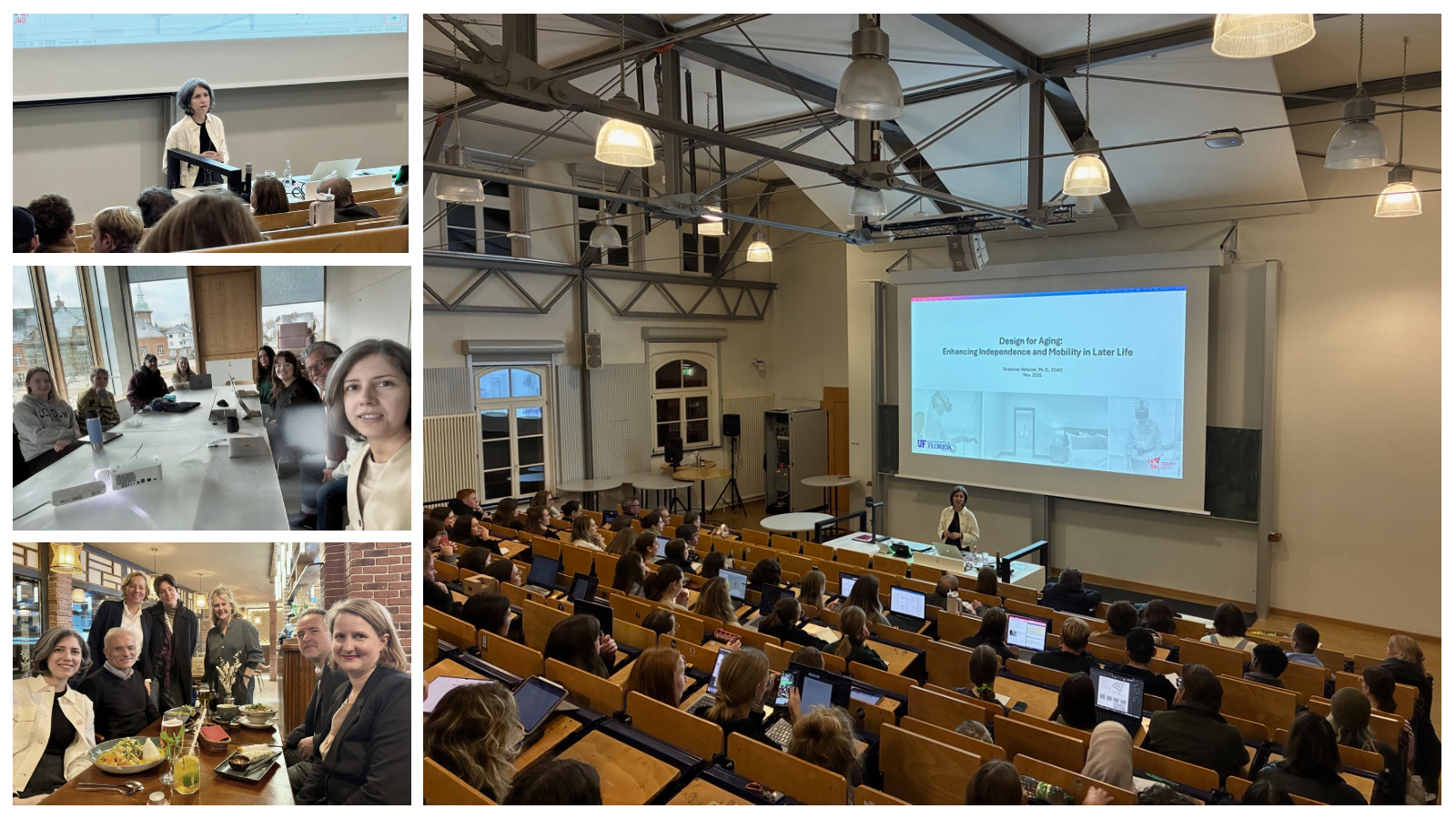
The centerpiece of Dr. Valipoor’s visit was a public lecture in the Detmold School of Design’s Dienstagsvorträge (Tuesday Lectures) series, a long-running format that brings external speakers from across the built environment disciplines to campus to expose students to current debates in practice and research.
Her talk, titled “Design for Aging: Enhancing Independence and Mobility in Later Life,” invited students and faculty from architecture, interior architecture, urban planning, civil engineering, and landscape architecture to consider what it means to design for a world with a much larger share of older adults. Drawing on her work in inclusive design and healthcare environments, Valipoor highlighted recent and ongoing research at UF, emphasizing the crucial role of cross-disciplinary collaboration in supporting health, safety, and quality of life in later years.
The Q&A that followed evolved into a broader conversation about the role of designers and planners in helping societies adapt to demographic change, and how interdisciplinary work, linking design, planning, health, and engineering, can move this agenda forward. The key takeaway for students in the auditorium was to treat the global trend of population aging not only as a challenge but as a design opportunity. As Valipoor noted, today’s students will live longer than previous generations; the decisions they practice making as designers today will shape the environments they themselves inhabit in later life.
The lecture also served as the opening event for the Wohnmedizinisches Symposium (Housing and Health Symposium), an annual forum that has, since 2011, brought together experts across design and health to explore how the built environment can support healthier living.
Meetings with Leadership: Exploring New Avenues for Collaboration
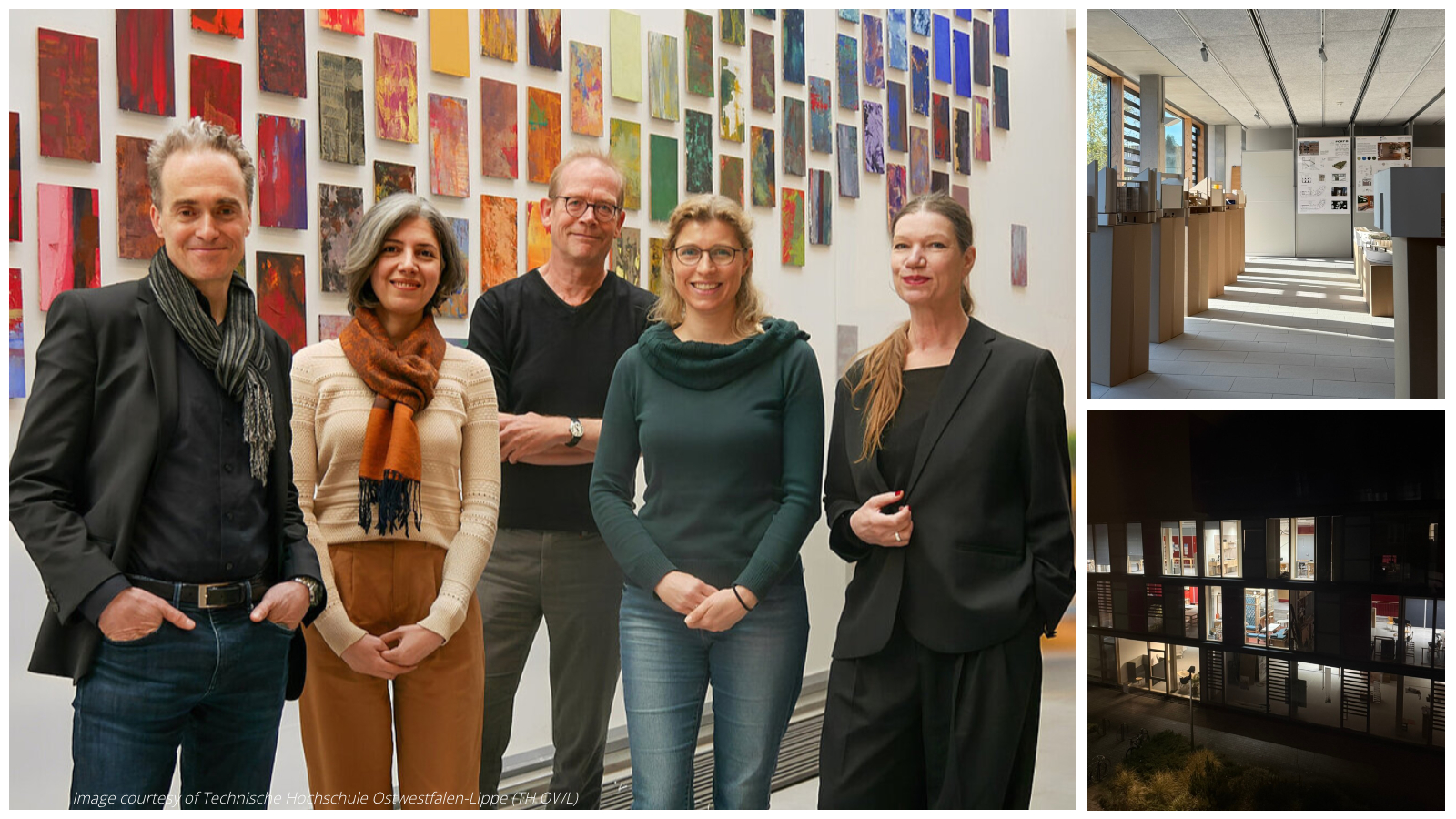
Another highlight of the visit was a meeting with the Dean and Vice Deans of the Detmold School of Design to discuss how UF and TH OWL can deepen their collaboration. The conversation focused on opportunities for joint research in human-centered design, expanding student mobility and short-term study opportunities, and exploring the possibility of parallel studios that connect UF and TH OWL students around shared design problems. Dean Martin Ludwig Hofmann expressed strong support for strengthening the partnership with DCP, particularly in areas of human-centered design and sustainability where both schools have ongoing initiatives.
“UF is an R1 research university and TH OWL is a technical university,” Valipoor notes. “That mix is a real strength. We each bring different capacities, and that makes cross-institutional work more interesting and more grounded.”
Research Conversations with the Institute for Design Strategies (IDS)
During her stay, Valipoor met with faculty, postdoctoral researchers, and graduate students at the Institute for Design Strategies (IDS), TH OWL’s research hub focused on transforming architecture and planning disciplines toward sustainable, human-centered environments. IDS organizes its research around three clusters: Data-Driven Design, Regenerative Design, and Human-Centered Design, in order to explore synergies between different scales of the built environment and their impact on health, comfort, and quality of life.
Current and recent IDS projects, supported by entities such as the City of Detmold, the European Union, Horizon Europe, the Federal Office for Logistics and Mobility (BALM), and Germany’s Federal Ministry of the Interior, Building and Community (BMI), provided a concrete backdrop for discussing future collaborations that link design, health, and mobility. These conversations opened the door to potential comparative projects in the future on topics such as accessibility on campuses, nature-based solutions for mental well-being in public spaces, and the use of digital tools to evaluate user experience in healthcare and community environments.
Teaching Involvement
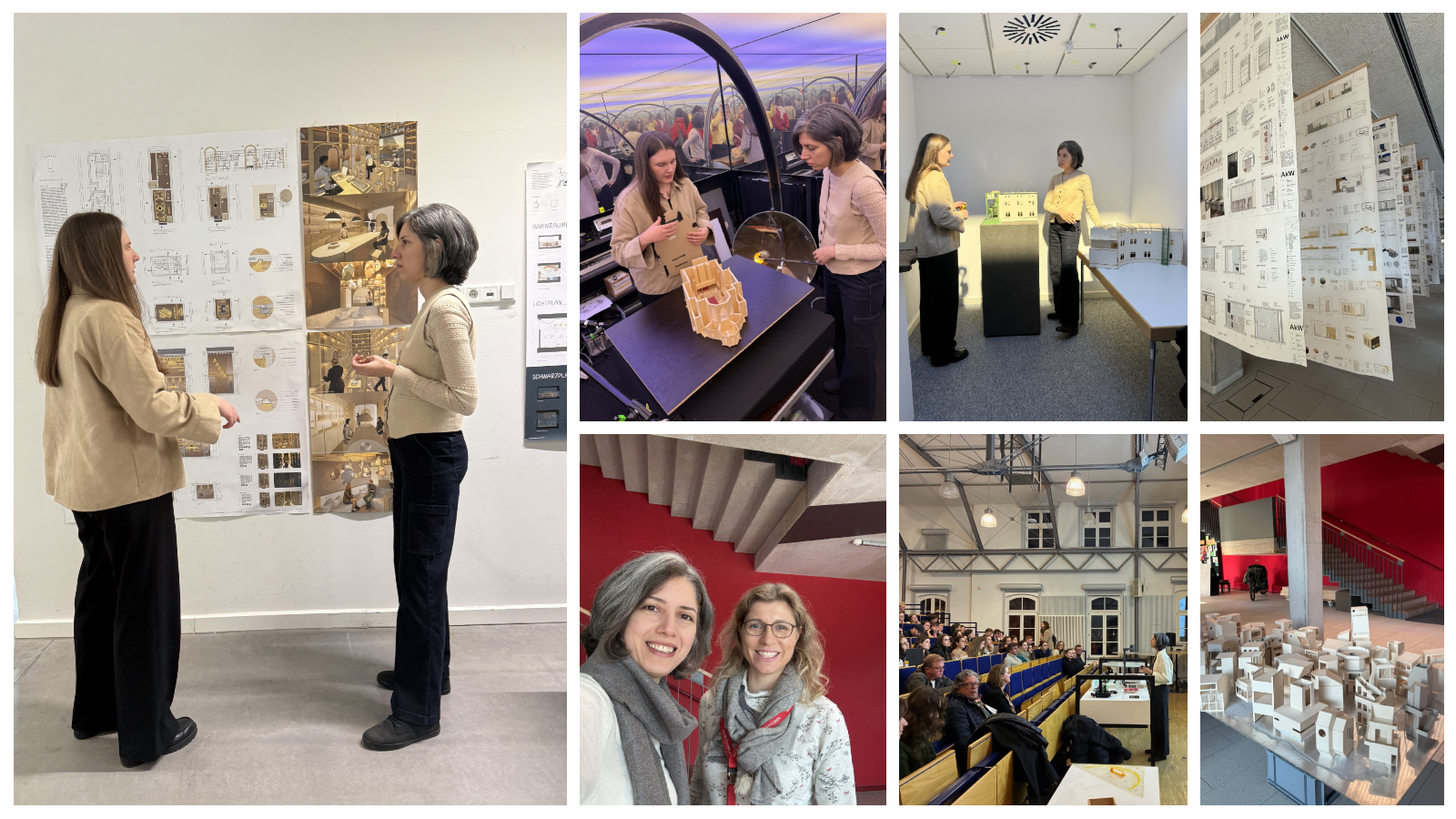
In addition to her public lecture, Valipoor participated in teaching and student-centered activities across multiple levels of the curriculum. She joined a senior interior architecture studio working on a national design competition focused on new learning environments, where students proposed design strategies for a Brutalist-era building on the Universität Duisburg-Essen (UDE) campus. The competition, organized by the architecture and interior design firm bkp Architekten in collaboration with the state real-estate agency Bau- und Liegenschaftsbetrieb NRW (BLB NRW), challenged students to rethink how existing educational buildings can support lifelong and flexible learning.
Her review sessions also included a second-year interior architecture class, where students were developing proposals that integrate inclusive design principles into a range of environments, including senior living, public offices, and retail spaces. In a senior lighting design course, students were working on lighting concepts for Münster University Hospital (UKM), linking technical lighting strategies with patient and staff experience. Through a guest lecture, Valipoor contributed perspectives from healthcare design research, discussing how light may affect orientation, comfort, and stress in clinical environments. The lighting education in the School of Design is also supported by a cutting-edge Lightlab, which Valipoor visited and highlighted as a valuable resource for UF students who have participated in the Summer Academy in Detmold in recent years.
She also met with faculty and students in the Master of Integrated Design (MID) program, an international master’s program taught in English with two specialization tracks: Computational Design and Façade Design.
Continuing Partnership
Valipoor emphasizes how visits like this strengthen ties between the two institutions and directly benefit students and faculty on both sides. She credits the many people who met with her and helped make the visit fruitful but adds, “I especially want to thank Sandra Bomholt in the Internationalization Office at the Detmold School of Design for working closely with me more than a year in advance to ensure that the visit was productive and filled with meaningful interactions.”
She also points out that she was not arriving as a stranger: “Thanks to our exchange program, I had already taught some students from Detmold in my UF classes and followed some of the fascinating work being done by faculty there. But nothing compares to being on campus, meeting people in person, and feeling the spirit of the place.”
The exchange program is coordinated by Professor Mary-Anne Kyriakou, Professor of Lighting Design and Lighting Architecture at TH OWL, who serves as the primary liaison for cooperation with DCP and as project leader of the German Academic Exchange Service (DAAD)-funded program. She also directs the Detmold Summer Academy and leads the Lightlab, both of which have provided UF students with rich, hands-on learning experiences in Detmold in recent years.
Valipoor acknowledges the support of DAAD, the Department of Interior Design, and the DCP Dean’s Office, whose backing made the visit possible and helped strengthen an international partnership that advances UF’s efforts in design, health, and global engagement.