
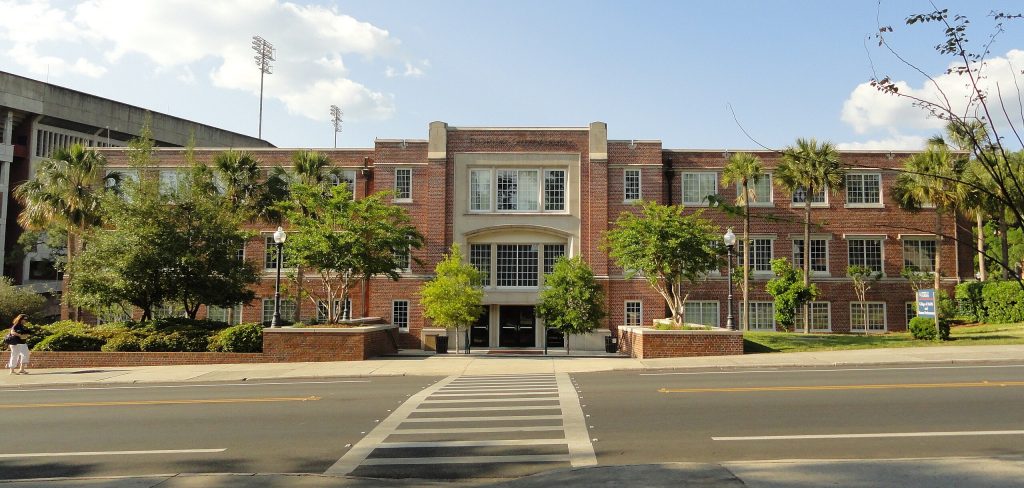
Last year, the University of Florida celebrated the men’s basketball team winning their third national championship. This year, the Witters Competition focused on the Gators’ previous home, the Florida Gym, reimagining what it could look like and focusing on a new future for the building.
The Florida Gym, home to the University of Florida College of Health and Human Performance (HHP), opened in 1949 as a 7,000-seat multi-purpose arena that was home to the Gator men’s basketball team and was known as “Alligator Alley.”
Most of the original floor plan has been remodeled as the building was adapted for different uses over the years, but the court surface remains and is used for student recreation and other purposes.
Situated next to Ben Hill Griffin Stadium, this historic building currently houses departmental and dean’s offices, research laboratories, two full-length basketball courts, six 100-plus seat lecture halls, classrooms, reading rooms and faculty locker rooms.
Today, the building experiences issues with poor infrastructure, including pipes that frequently burst, problems with the HVAC system and water intrusion from rain events. There are also significant issues with wayfinding that have been temporarily addressed with adaptations and signs.
So HHP asked the students from the Witters Competition to help reimagine a new future for the Florida Gym. The college sought big ideas from the students, organized within a strong holistic design approach, that are legacy-focused to address its needs.
“The Florida Gym is an architectural treasure that has housed our college and served UF for 77 years,” HHP Dean Michael Reid said. “Now is the time to rejuvenate this icon, expanding its academic capacity and modernizing the interior for future generations of the Gator Nation.”
HHP is interested in converting the original volume of the gymnasium into a minimum of two levels of usable academic and common space. The college currently has space in Yon Hall (within Ben Hill Griffin Stadium), and they will be displaced from that space upon renovation of that stadium. Therefore, the college will have to recoup lost space within the Florida Gym.
In addition, temporary teaching labs were created in the 2000s on a portion of the original gymnasium floor by installing a false floor, walls and a drop ceiling. So these labs would have to be removed to reveal the original gym, then reimagined and reconfigured into the new design concept. The students’ proposal would also have to convert existing locker rooms into academic space as well.
HHP also wanted the students to envision five specialized areas in the new space to promote interdisciplinary work: Teaching Lab for Robotics, Teaching Lab for Sports Analytics, Community Health Research Lab, Iron Gators Teaching Fitness Lab, and the Anatomy and Physiology Lab.
While there are many improvements that can be made to the interior of the space, the students had to adhere to the historic considerations. Since the building is on the National Register of Historic Places, the building’s façade cannot be changed. Also, the existing wood gymnasium floor must be repurposed and incorporated into the final design in a creative way.
Armed with all this information, the students worked from Thursday evening until Sunday at 3:30 p.m. and submitted their work to the jury, who chose five teams to move on to the finals to present for their chance at the grand prize.
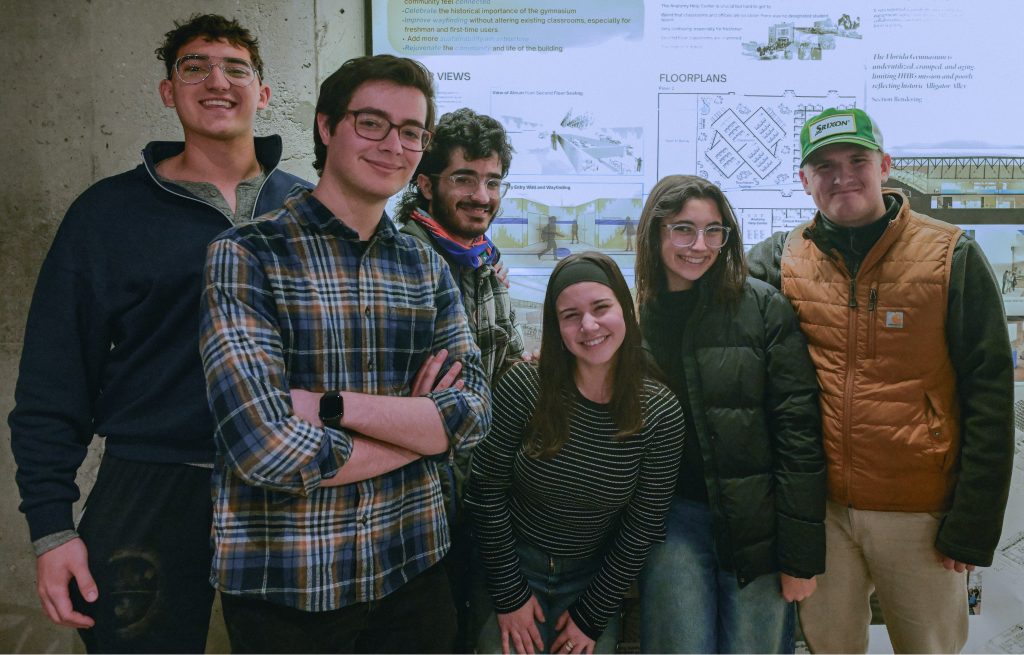
After all the amazing work was submitted, the jury ultimately chose team 11 as the grand prize winners: Roiler Acosta, Aelly Alwardi, Logan Chappell, Gabriella Childers, Sofia Lopez and Isidoro Vilarino. Their team gets to split the $8,000 grand prize.
“The students’ professionalism and creativity were stunning,” Reid said. “Without a doubt, concepts developed by the students will inform the Gym renovation project and enhance the future building.”
The Witters Competition began in 1993 from an endowment by Arthur G. and Beverley A. Witters to sponsor an interdisciplinary academic competition to foster better understanding among design, construction, planning and engineering students.
As each student on the team provides input regarding their part of the project, the team learns more about the other academic disciplines and the issues affecting their work.
“It was a pleasure to once again participate in the annual Witters Competition,” Tucker Ryals, the Witters’ grandson and member of the jury said. “The 2026 edition was especially impactful as the subject was the renovation of the historic UF gymnasium. Having a real-life project as the focus was fantastic. It is not only an iconic building but also one that is on the university campus. The project that may well come to fruition while many of the competition participants are still students – giving them a chance to see some of their ideas take shape in the physical world and certainly a point of pride whenever they visit as an alumnus.”