
Friday, October 30, 2026
From growing up in Croydon, South London, to pursuing her dream of becoming a project engineer in the United States, a University of Florida graduate student is bringing together the influences of her upbringing, her passion for engineering and her commitment to sustainable design. Inspired by her father’s work in construction and her mother’s eye for detail and interior design, she developed an appreciation for how thoughtful design can shape the spaces people live, work and learn in. Today, she is applying that perspective to an innovative project that gives discarded aluminum cans a second life as a smart speaker designed to support healthier learning environments.

Marian Aburam has never been much of a soda drinker. That made the sight of discarded aluminum cans piling up around the University of Florida campus all the more striking.
While other students might see an empty Celsius or Pepsi can as something to toss into a recycling bin, Aburam saw an opportunity. What if those cans could become something useful again, something that did more than keep waste out of a landfill? What if they could help make the classrooms where students spend hours studying healthier places to learn?
That question became the foundation of her thesis research at UF’s College of Design, Construction and Planning (DCP), where Aburam is pursuing a master’s degree in integrated sustainable development. Her answer is the Hive Sensor Speaker, a prototype that combines upcycled aluminum cans, reclaimed wood and smart technology to monitor indoor air quality.
Think of it as an Alexa speaker with an additional job. Along with its speaker function, the device contains a sensor that monitors conditions inside a room. Green and red indicator lights provide an at-a-glance signal of air quality, while a digital system records readings over time. Instead of requiring someone to check a monitor and interpret its numbers, the speaker is designed to make changes in the indoor environment easier to recognize.
The idea brings together two problems that are often considered separately: what happens to materials after people throw them away and what happens to the air people breathe inside the buildings they occupy.
For Aburam, those questions are inseparable.
“I actually don’t like fizzy drinks,” she said. “So, seeing the mass amount around campus was like, oh wow, people really do drink Celsius in the mornings, in the afternoons.”
She began looking at those cans differently during a circular economy course, which challenged students to consider how materials could remain useful rather than follow the familiar path from production to disposal. Aluminum offered a promising starting point. The can is widely available, with it being able to be cut open and flattened into a sheet of metal that can be repurposed.
But Aburam wanted the idea to do more than demonstrate recycling. She wanted to create something people could use.
“I think the fact that it’s a relatable product” is what makes her proud of the project, she said.
That relatability starts in the classroom. After spending years in higher education, including long sessions in Florida classrooms during the summer, Aburam had experienced firsthand how uncomfortable an indoor environment can become. She recalled classes in which students opened doors and windows despite the air conditioning running, struggling through three-hour lessons in the heat.
“When you’re uncomfortable or you’re heat stressed and you want to go home,” she said, “what are you really actually learning?”
The Hive Sensor Speaker grew from that frustration into a practical research question: Could a product made from discarded materials also help people better understand the environments in which they study and work?

With guidance from Patricia Kio, a DCP professor and Aburam’s research advisor, she began developing the concept. The prototype incorporates an indoor air quality sensor, and its digital component uses blockchain technology to preserve a record of readings. In simple terms, that record can help users follow how indoor conditions change over time rather than relying on a single measurement.
The indicator lights are intended to make the information accessible to people who may never think of looking at an air quality monitor. A red light signals that conditions have fallen below the applicable university standard used as a reference, while green indicates a different status. The technology is still in the prototype stage, and further development will be needed to refine its capabilities.
The larger goal is straightforward: make information about indoor environments easier to see and use, particularly in places such as classrooms, studios and other shared spaces where people spend long stretches of time.
“Marian’s project demonstrates a strong circular economy approach by upcycling discarded cans and wood into higher value products,” Kio said. “She also integrated a blockchain-based strategy developed during her master’s studies in construction management to enable real time indoor air quality monitoring.”
Kio sees potential beyond the speaker itself. The project demonstrates how reclaimed materials and smart building technology can work together, offering a model for future products that address both waste and the quality of indoor spaces.
“By using reclaimed materials in the speaker’s construction, the concept reduces waste and dependence on virgin resources while creating a functional product,” Kio said. “This combination of environmental monitoring and material reuse makes the technology meaningful not only for educational environments but also for the broader built environment.”

Learning to see what comes next
Aburam’s interest in sustainability did not begin with a soda can. It grew from a lifetime of watching people build, renovate and make the most of what they have.
Her father has worked in construction for 25 years. When Aburam was growing up, he bought and renovated homes and even built small homes on limited parcels of land. Her family did not have a great deal of money, but she watched him turn modest resources into something substantial.
“He made something big out of something small,” she said.
That example stayed with her. Before coming to UF, Aburam studied construction management at the University of Reading in England and gained experience through internships with Turner Construction, where she worked as a sustainability engineer, and Balfour Beatty, where she worked as an estimator intern.
Those experiences also exposed her to differences in how sustainability is approached in the United Kingdom and the United States. Growing up in the UK, she was accustomed to stronger European influences on sustainability, including regulations that shape the construction industry. The contrast in the United States surprised her.
She does not see that difference simply as a criticism. Instead, it revealed an opportunity to educate people and reconsider what the construction industry prioritizes.
Traditional construction, she explained, often focuses on delivering a finished building before moving on to the next project. Sustainability asks a different set of questions: What happens to the materials afterward? How long will a product remain useful? And can something that has reached the end of one life begin another?
That shift in perspective helped lead her beyond conventional construction management and toward circular design, which emphasizes keeping materials in use for as long as possible.
“Sustainability does not always require us to invent more things,” Aburam said when reflecting on her academic journey. “Sometimes it requires us to look differently at the things we already have.”
The Hive Sensor Speaker is one expression of that belief. Her initial plan was to make the entire speaker from aluminum cans. As she developed the prototype, however, she realized it needed more structural support and incorporated wood as another material.
The adjustment was a reminder that an innovative idea must also work in practice. She had to think about the product’s size, its construction and how someone might actually use it. Working with sensors and wiring presented a different set of challenges from her background in construction, too.
Still, seeing the concept take shape affirmed that the idea could become more than a classroom exercise.
And then came Japan.
A Gainesville idea reaches the world
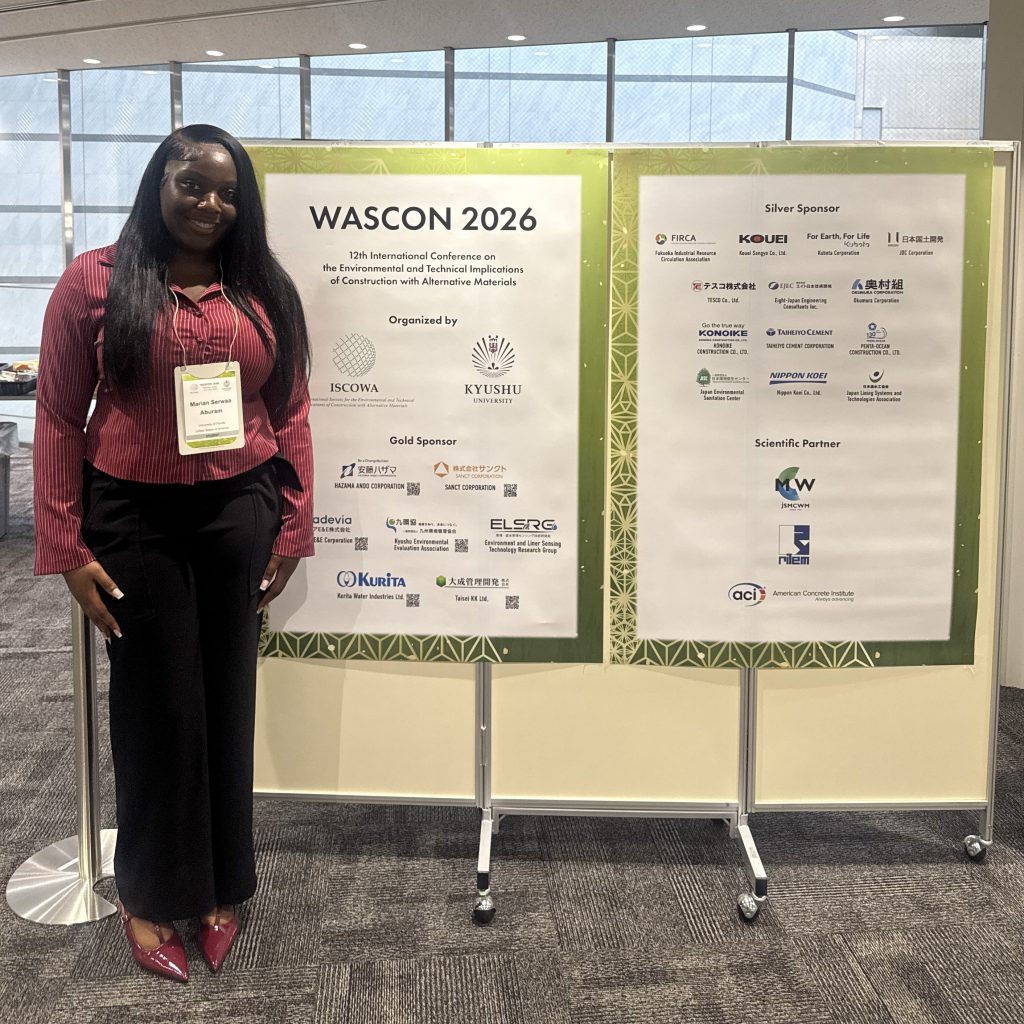
In 2026, Aburam traveled to Fukuoka, Japan, to present her research at WASCON, an international conference focused on sustainable construction and the built environment. It was her first solo trip, a major personal milestone that also changed how she viewed her work.
Until then, much of the encouragement she had received had come from professors and people within the university. Presenting to an international audience gave her a chance to see the project in a broader context and consider how it might contribute to conversations about sustainability around the world.
“It was honestly life changing for me,” she said. “I really realized that there’s potential in my ideas.”
The experience reinforced her belief that sustainability is a universal concern and that an idea developed in Gainesville can have relevance far beyond Florida. It also gave her a different kind of confidence, one that came from sharing her work with people who had no connection to her classroom or her university.
There was a personal significance, too. Aburam recalled being the only Black woman in the room, an experience that made her think about the people who might follow her into spaces where they have not always seen themselves represented.
“I never had someone like me in those spaces that came to tell me that they did what they did,” she said. “If I’m able to do it, there’s a chance that anyone else can do it too.”
She is still processing what the experience means. Perhaps, she said, it will fully sink in one day when she can tell her children about presenting her research in Japan.
For now, the trip has become a reminder that research can open doors she never expected to walk through.
It also helped her recognize that the speaker could have a future beyond her thesis.
With support through UF, the project advanced to a provisional patent filing. Before her experience at the university, Aburam had not realized that patent protection could be an option for an invention like hers.
“If it wasn’t for UF in general, I wouldn’t have thought about getting a patent on my product,” she said. “I didn’t even know that that was a thing. To be honest, I thought it was more like in the fashion industry.”
Kio and the research team have also pursued support through UF Innovate to explore the technology’s development and commercialization. The concept’s commercial potential is being examined through an NSF Innovation Corps program, which helps academic innovators assess market needs through conversations with potential customers and stakeholders. That work may help identify a path for technologies like the Hive Sensor Speaker to move beyond research and into practical use.
For Kio, the journey illustrates the kind of opportunities DCP can offer students: the chance to take an idea from coursework to a prototype, explore intellectual property and share research with a wider audience.
“DCP fosters an environment where students can develop technical and professional skills while applying their knowledge to address real-world challenges,” Kio said.
The experience has also helped prepare Aburam for her next chapter. She is interested in gaining more hands-on experience in construction before pursuing a longer term goal inspired by her father: opening her own property development business.
She wants to buy and renovate homes with sustainability built into the process, creating properties that are both environmentally responsible and affordable. Her aim is to offer people the kind of home that feels luxurious without putting sustainable living out of reach.
It is a natural extension of what she learned watching her father work. It also reflects the principle behind her speaker: look at what already exists, recognize what it could become and find a way to make it serve people better.
As she prepares to complete her master’s degree in December 2026, Aburam hopes her work will encourage others to think differently about sustainability and who gets to shape the future of the built environment.
“It can be you,” she said. “It could be anybody that can get into what I’m getting into.”
For Aburam, the speaker is more than a device made from discarded cans. It is evidence that a small observation can become a meaningful idea, that an idea can grow with the right support and that innovation does not have to begin with something new.
Sometimes, it begins with something everyone else has thrown away.