Monday, February 9, 2026
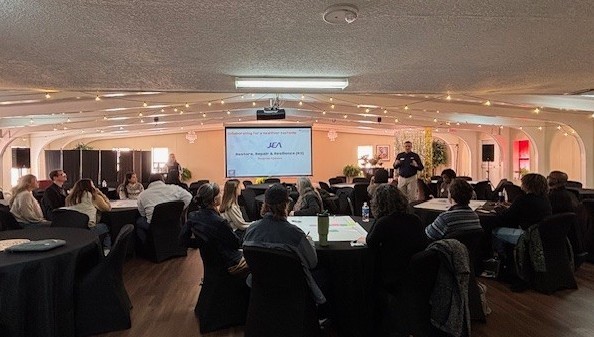
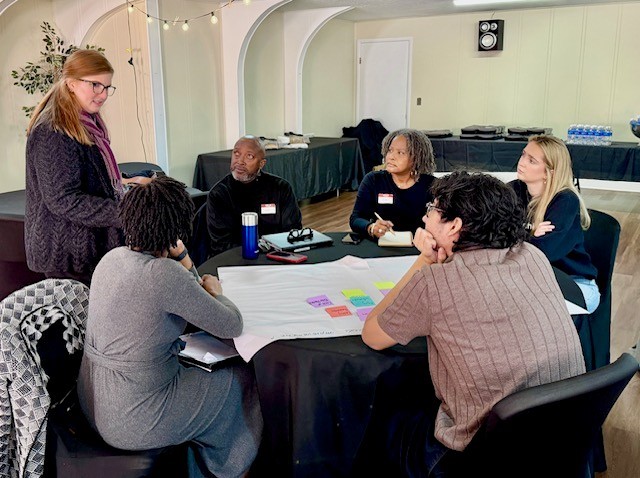
The Sustainable and Supportive Housing Design for Salutogenic Health (S³) initiative recently convened a community design charrette in Jacksonville’s Historic Eastside, bringing together neighborhood residents, community partners, and University of Florida faculty and students to envision healthier, more supportive housing and public spaces. Over the course of four hours at the Church of Oakland, participants explored how housing and community design can advance health, well-being, and sense of belonging for Eastside residents.
“As PI for the S³ initiative, I left this charrette deeply encouraged by what can happen when Eastside residents, community partners, and our UF design students sit at the same table to imagine healthier futures together,” said Lisa Platt, an assistant professor for interior design at UF. “The ideas we heard made clear that housing and neighborhood design are not abstract questions of form; they are everyday determinants of health, dignity, and opportunity in Jacksonville’s Historic Eastside. This gathering is an important first step, and our team is committed to continuing this collaboration so that community knowledge and design research move forward hand in hand.”
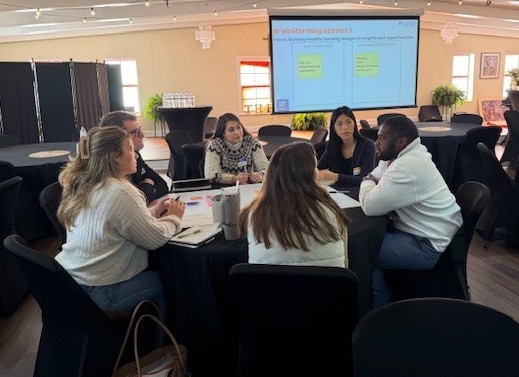
The event featured UF College of Design, Construction and Planning (DCP) resource demonstrations, small-group brainstorming sessions, and a group synthesis to identify priority challenges, opportunities, and design tools for improving community health. Discussions focused on the relationships between housing quality, neighborhood amenities, and salutogenic (health-promoting) environments.
The S³ team extends its gratitude to the LS3P Foundation, whose grant funding made the charrette possible. Organizers also thank the Church of Oakland for serving as host venue and providing a welcoming space in the heart of the Eastside neighborhood.
Community partners played a central role in the day’s dialogue, including representatives from JEA Utilities, United Way of Northeast Florida, and UF Health Jacksonville. Special appreciation is extended to members of the Historic Eastside Resident Alliance, whose lived experience and vision grounded the conversations and helped ensure that community priorities remained at the forefront.
Undergraduate and graduate students from DCP were instrumental in facilitating and documenting the work, representing the JaxLab CityLab–Jacksonville graduate Architecture program, the Department of Urban Planning, the Department of Landscape Architecture, and the Department of Interior Design. Their contributions supported each phase of the charrette, from table facilitation and notetaking to reporting back key themes during the final session.
S³ steering committee members in attendance included, in alphabetical order, Nancy Clark (School of Architecture and Program Coordinator, JaxLab CityLab–Jacksonville), Erin Cunningham (Interior Design), Ruth Steiner (Urban & Planning), Shabboo Valipoor (Interior Design), and Mike Volk (Landscape Architecture). The organizers also recognize the DCP Department of Interior Design and SAMPL material intelligence co-creator Dr. Arezoo Zeinali for her support, and S³ Graduate Research Assistant lead Milena Rodriguez Mendez for her facilitation expertise and coordination throughout the event.
The S³ Community Charrette marks the beginning of an ongoing collaborative effort to advance sustainable, supportive, and health-promoting housing and public realm design on Jacksonville’s Eastside. Future activities will continue to center community voices while drawing on interdisciplinary design research and practice to improve health outcomes and quality of life in the neighborhood.