
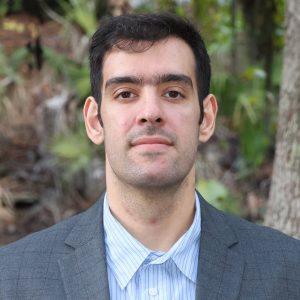
Looking to translate research into real-world coastal resilience, University of Florida Ph.D. student Mojtaba ‘Mo’ Tahmasebi has collaborated with the U.S. Army Corps of Engineers (USACE), U.S. Army Engineer Research and Development Center (ERDC), and the UF Center for Coastal Solutions.
This past year, he attended a cooperative workshop in Vicksburg, Mississippi, hosted by the ERDC, where he joined fellow colleagues along with UF faculty for a week of presentations and discussions on advancing nature-based coastal resilience. Representing the UF Department of Landscape Architecture, he showcased two of his current research projects that demonstrate the vital connection between design, data, and environmental science.
“It was an incredible experience to share my work alongside ERDC researchers and UF colleagues,” Tahmasebi said. “The workshop highlighted how collaboration across disciplines, and across institutions, can lead to innovative, nature-based solutions for our nation’s most pressing climate challenges.”
His first project, “Coastal Carbon at Risk: Forecasting the Impacts of Sea-Level Rise on Future Land Cover,” was published shortly after the workshop on July 13, 2025, in Frontiers in Ecology and Evolution (Conservation and Restoration Ecology section). The research, conducted as part of the Coastal Adaptation Through Nature: Natural and Nature-Based Features (NNBF) initiative, is supported by the U.S. Department of Defense through USACE-ERDC.
“My work examines how sea-level rise and land-cover changes impact coastal ecosystems’ ability to store carbon,” Tahmasebi explained. “By combining spatiotemporal modeling with ecological data, we can forecast where and how these natural systems may be most at risk—and where restoration or design interventions could make the biggest difference.”
His second project, which is still in review, concentrates on urban-coastal flood resilience. Using a baseline Resistance, Adaptation, and Recovery framework, Tahmasebi is developing objective weighting methods to better assess vulnerabilities and identify strategies for improving resilience in urban and coastal environments. “This research helps cities understand not just where they are vulnerable, but how to prioritize investments in infrastructure and ecosystem restoration to reduce long-term risk,” he said.
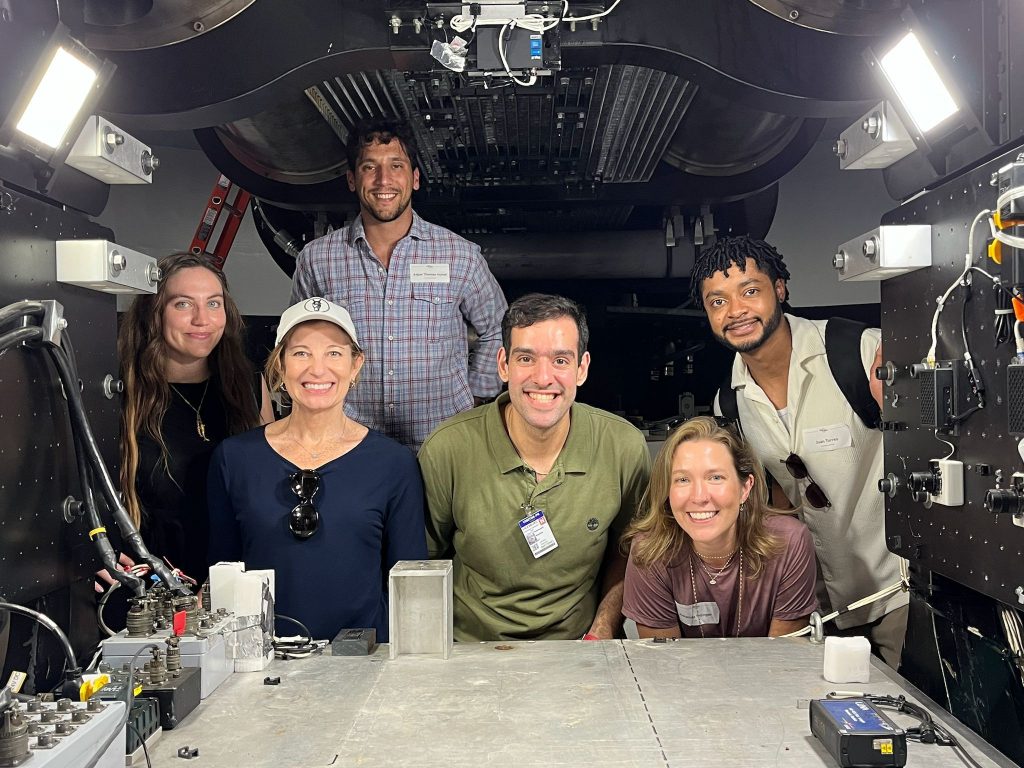
Following the workshop in Mississippi, Tahmasebi and Dr. Jules Bruck, chair of the UF Landscape Architecture program, also spoke with USACE and other partners about future proposals and publication collaborations. The team is currently working with Jacobs Engineering and the Engineering With Nature (EWN) program on scenario visualization, graphic guidelines, and nature-based design strategies for coastal resilience research.
Tahmasebi is using all this momentum to begin an anticipated third project under the USACE initiative, Developing Engineering Practices using Ecosystem Design Solutions (DEEDS) for the Future Army. His role will focus on maximizing thin-layer placement benefits through a landscape-architecture approach, including the creation of an ecosystem services assessment, carbon storage and sequestration, which in turn will support sustainable infrastructure design.
“These collaborations have shown me how design thinking and environmental modeling can work hand in hand to deliver measurable resilience,” Tahmasebi said. “It’s incredibly rewarding to see landscape architecture contributing directly to national resilience efforts.”
In addition to his work with USACE-ERDC, he was recently awarded a grant to attend the 2025 National Science Foundation (NSF) NHERI RAPID Natural Hazards and Disaster Reconnaissance Workshop at the University of Washington. The four-day program offered hands-on training in LiDAR, drone imaging, mobile sensors, and the NHERI DesignSafe-CI platform—tools he has applied in his ongoing flood resilience research.
“The NHERI workshop expanded my technical skills and deepened my understanding of post-disaster field methods,” he said. “It was also a chance to connect with researchers across disciplines who share the same goal of creating safer, more resilient communities.”
Tahmasebi credits his success to UF’s supportive academic environment, where collaboration between design, science, and engineering fuels innovation. “UF has been the perfect home for my research,” he said. “The university’s strength in artificial intelligence, spatiotemporal modeling, and environmental resilience has allowed me to pursue data-driven solutions that have real-world impact.”
His journey first began at the University of Guilan in Iran, where he studied architectural design. After his passion for environmental design exploded, it led to a deep commitment to landscape-scale resilience – One he’s been able to pursue fully in Gainesville. “Through my discussions with Dr. Bruck, I realized UF provided the perfect place to develop my skills, collaborate on impactful research, and contribute to projects that address real-world environmental challenges,” he said. “UF is my home—a place where my passion for coastal resilience, landscape modeling, and data-driven risk assessment has flourished.”
With dreams of becoming a researcher and educator, Tahmasebi’s main goal is to advance coastal resilience at the intersection of science, design, and policy. “My UF experience—spanning interdisciplinary research and teaching—has prepared me for an academic career that integrates rigorous scholarship with mentorship and real-world problem solving,” he said.
Beyond research, he’s deeply committed to shaping the next generation of landscape architects and scientists. “I want to mentor future students so that the impact multiplies through the people I help train,” he finished with.