Career Preparation & Pathways
SBE & Green Job Skills
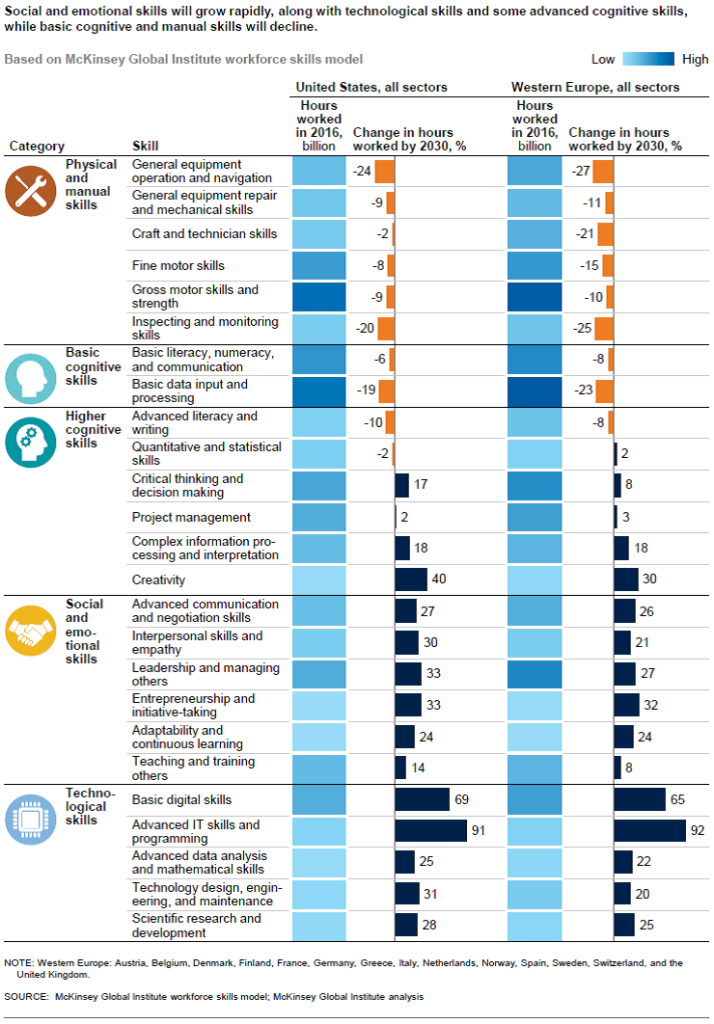
As robotics, machine learning, and computational capacities continue to expand, the global workforce will see a shift in skills that reinforces the importance of the UF DCP SBE program. Specifically, within the United States and Western Europe, significant growth in hours worked on higher cognitive skills, social and emotional skills, and technological skills will dominate workforce needs (Bughin, et al., p. 8). Within those three broad skill categories projected to grow in our workforce, more specific skills like advanced IT skills and programming; basic digital skills; creativity; entrepreneurship and initiative-taking; leadership and managing others; technology design, engineering, and maintenance; and interpersonal skills and empathy are all expected to see increased skill growth rates of 30% or more (Bughin, et al., p. 9). Complementary analyses include the eight soft skills “Career Readiness Competencies” framed by the National Association of Colleges and Employers (NACE).
The U.S. Bureau of Labor Statistics (BLS) defines green jobs as: (A) Jobs in businesses that produce goods or provide services that benefit the environment or conserve natural resources; or (B) Jobs in which workers’ duties involve making their establishment’s production processes more environmentally friendly or use fewer natural resources. Collectively, these jobs produce goods and provide services, as well as include workers’ duties, that fall into five major groups: (1) Energy from renewable sources; (2) Energy efficiency; (3) Pollution reduction and removal, greenhouse has reduction, and recycling and reuse; (4) Natural resources conservation; and (5) Environmental compliance, education and training, and public awareness. As of 2009 industry sector data, approximately three quarters (74.3%) of the establishments producing green goods and/or providing green services were in the “Construction” and the “Professional and Business Services” sectors.
Career Readiness Competencies
Soft Skills
The National Association of Colleges and Employers (NACE) frames seven core soft skill competencies that are critical to career success and reinforced by the SBE Program. The award winning UF Career Connections Center (C3) offers a comprehensive suite of curated resources, professional development services, and interactive tools, such as the Career Help or Major Planning (CHOMP) student self-awareness and career readiness assessment. Below are highlights of these competencies as excerpted from the NACE > What is Career Readiness? web page.

Critical Thinking
“Identify and respond to needs based upon an understanding of situational context and logical analysis of relevant information.”

Communication
“Clearly and effectively exchange information, ideas, facts, and perspectives with persons inside and outside of an organization.”

Teamwork
“Build and maintain collaborative relationships to work effectively toward common goals, while appreciating diverse viewpoints and shared responsibilities.”

Technology
“Understand and leverage technologies ethically to enhance efficiencies, complete tasks, and accomplish goals.”

Leadership
“Recognize and capitalize on personal and team strengths to achieve organizational goals.”

Professionalism
“Knowing work environments differ greatly, understand and demonstrate effective work habits, and act in the interest of the larger community and workplace.”

Career & Self-Development
“Proactively develop oneself and one’s career through continual personal and professional learning, awareness of one’s strengths and weaknesses, navigation of career opportunities, and networking to build relationships within and without one’s organization.”
State University System of Florida | MyFloridaFuture Tool
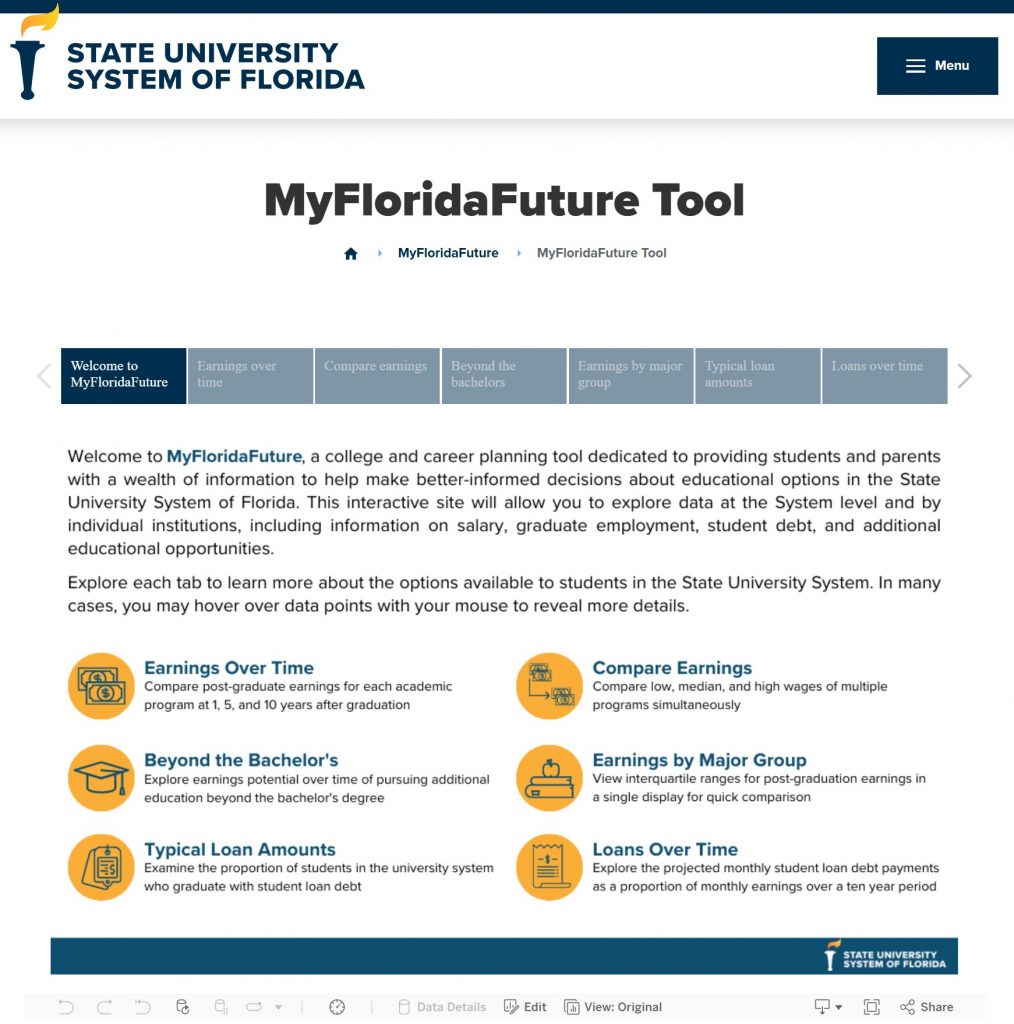
In support of student and parent evaluation of the academic possibilities in our public universities, the State University Systems (SUS) of Florida created the MyFloridaFuture Tool. This dashboard projects future earning potentials based on periodic surveys of alumni postgraduate outcomes across a multitude of baccalaureate and graduate degrees. To explore the tool for yourself, you can click over to the SUS of Florida portal with the button below.
SBE Program Classification & Strategic Emphasis
The Program in Sustainability and the Built Environment (SBE) is an academic unit within the College of Design, Construction, and Planning (DCP) at the University of Florida (UF). This Science, Technology, Engineering, and Mathematics (STEM) based program, classified under CIP Code 30.3301 (Sustainability Studies), is one of only three bachelor degree (FIU, UF, and USF) and only two master degree (UF, USF) sustainability programs within the State University System (SUS) of Florida. As of the 2022-2023 academic year, the SBE Program is further classified by the SUS as a Program of Strategic Emphasis (PSE) within the “Economic Development – STEM” category. Beyond the official SBE Program CIP Code 30.3301 (defined below), additional Multi/Interdisciplinary Studies (30 series) CIP Codes that are connected to the SBE Program curricula and job skills include, but are not necessarily limited to, the following (listed in numerical order):
CIP Code 30.06 | Systems Science and Theory
A program with a multidisciplinary approach to the analysis and solution of complex problems, requiring a combined approach using data and models from the natural, social, technological, behavioral and life sciences, and other specialized fields.
CIP Code 30.3301 | Sustainability Studies
A program that focuses on the concept of sustainability from an interdisciplinary perspective. Includes instruction in sustainable development, environmental policies, ethics, ecology, landscape architecture, city and regional planning, economics, natural resources, sociology, and anthropology.
CIP Code 30.4101 | Environmental Geosciences
A program that focuses on the scientific study of the environmental implications of geological processes and human activities on Earth. Includes instruction in environmental/natural resource management, geographic information systems (GIS), geology, hydrology, regulatory agency compliance, hazard identification and mitigation, environmental law, environmental policy, and sustainability studies.
CIP Code 30.4401 | Geography and Environmental Studies
A program that focuses on interactions between people and the natural and built environments. Includes instruction in climate science, sustainability, environmental science and policy, research methods, geographic information systems (GIS), human geography, physical geography, remote sensing, and public policy.
SBE Related Career Profiles
SBE is an interdisciplinary program by design. As such, we both attract students with varied interests and train students for diverse career pathways. In many cases, our students are generalists who feel most comfortable when they are unbound by conventional boxes and given the freedom to create connections within the space beyond and between boxes. Thus, there is neither a prototypical SBE student, nor a definitive career profile that is best suited to their capacities and career goals. SBE students come to understand critical concepts across common coursework which lays the foundation for their generalist skills. Yet, they hone their more specialist skills across curated clusters of electives.
The UF C3 Career Pathway Community best suited to SBE students is Architecture, Manufacturing, Natural Resources and Agriculture. Additionally, showcased below are O*NET profiles for careers that an SBE may ultimately strive to pursue at the appropriate stages of their professional development. This list is merely a snapshot to support student self-reflection on the types of career opportunities that may be possible if they strategically integrate the generalist skills of the SBE common coursework with the specialist skills of the student choice electives. If you’d like to better align your interests with these, and other potential careers, try the O*NET Interest Profiler assessment.
Building Performance
Natural Resource & Land Use Management
Organizational Sustainability
Renewable Energy
Green Building Profiles
Another helpful resource might be the Green Building Profiles playlist on the U.S. Green Building Council YouTube Channel. Currently, the following seven profiles have been showcased by individual professionals representing each of these disciplines:
Other DCP Related Career Profiles
Showcased below are a sampling of select career profiles for other DCP related disciplines. SBE students tend to display a variety of the knowledge, skills, abilities, personalities, and technologies summarized within and across these career profiles. However, if a prospective SBE student feels that any one of these career profiles feels specifically well suited to your talents and interests, you may be better served pursuing a degree within one of our other DCP academic programs.