
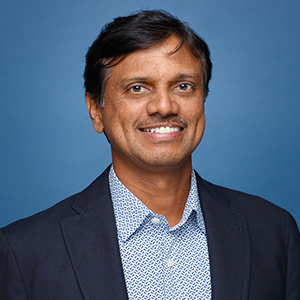
Ravi Srinivasan
Ph.D. in Architecture (Building Technology), University of Pennsylvania, Philadelphia, PA
M.S. in Architecture (Building Technology), University of Pennsylvania, Philadelphia, PA
M.S. in Civil Engineering, University of Florida, Gainesville, FL
Publications
Areas of Focus
Sustainability (Building Energy, Building Materials, Built Environment Resilience, Renewable Energy, Smart Buildings/Cities, Sustainable Architecture and Design, Sustainable Construction,, Sustainable Technology)
Developing dynamic sustainability information modeling (dSIM) platform; more info is available here: https://built-ecologist.com/2019/05/11/dynamic-sustainability-information-modeling-d-sim-for-smart-cities/
Biography
Dr. Ravi Srinivasan is an architect-scholar. Trained first in the design studio, he earned his B.Arch (First Class with Distinction) from the National Institute of Technology, India, and practiced architecture and interior design in India and Singapore (1996–2000) before earning his M.S. and Ph.D. in Architecture at the University of Pennsylvania; he has since co-taught the terminal Architecture Design 8 (D8) comprehensive studio in the University of Florida (UF) School of Architecture for several years. He has juried for Harvard GSD and presented seminars at Penn. He pairs that design lineage with technology and administrative leadership as the Associate Dean for Research and Strategic Initiatives in the College of Design, Construction & Planning (DCP) at the UF. In this executive capacity, he directs the creation and execution of college-wide strategic initiatives alongside the comprehensive governance of graduate, faculty, and research affairs across five academic departments and schools (architecture, construction management, interior design, landscape architecture, and urban & regional planning) serving more than 1,200 students and 150 faculty and staff, with direct executive reporting lines for the college’s multidisciplinary academic programs (Sustainability and the Built Environment; Historic Preservation) and the college-wide Ph.D. program. A tenured Full Professor, Dr. Srinivasan serves at the university level as the Co-Chair of the UF Council for Research Associate Deans (CORAD) and as a steering member of the UF Graduate School Advisory Council, shaping institutional policy across all 16 academic colleges.
A dedicated practitioner-scholar bridging design theory, spatial human factors, and advanced technology, Dr. Srinivasan has served as the Interim Director of the interdisciplinary SBE program—with 150 active students—and is an external faculty collaborator with the Center for Environmental Building & Design at the University of Pennsylvania’s Weitzman School of Design. He is the Director of the UrbSys (Urban Building Energy, Sensing, Controls, Big Data Analysis, and Visualization) Lab, where his research centers on computational design and design automation, leveraging Artificial Intelligence (AI), the Internet of Things (IoT), and digital twins to advance Net Zero Carbon buildings, human-centered interior environments, smart product systems, and resilient Smart Cities.
Dr. Srinivasan’s work reaches directly into interior and industrial design: virtual reality co-design methods that enable people with Parkinson’s disease to personalize their own residential interiors (with the UF Fixel Institute of Neurological Diseases), and IoT-enabled smart products — including a patented multisensory airquality system integrated into asthma-inhaler carrying cases — that join product design with sensing and human factors. This portfolio engages the defining pressures on the built environment — the energy transition, climate adaptation and flood resilience, affordable and post-disaster housing, and health across the lifespan.
Dr. Srinivasan has driven $10M in total research and strategic funding for his research lab, including $3M personally raised through foundation awards, corporate research gifts, and technology-transfer and venture agreements, alongside competitive extramural awards as PI and Co-PI from federal agencies such as the National Science Foundation, U.S. Housing and Urban Development, U.S. Veterans Affairs, and international foundations. Widely published, he has authored or co-authored 120 peer-reviewed journal articles, conference papers, and book chapters, accumulating ~7,500 citations with an h-index of 33 and i10-index of 71. He is the lead author of The Hierarchy of Energy in Architecture: Emergy Analysis (Routledge) and co-editor of Smart Cities: Foundations, Principles, and Applications (John Wiley & Sons). An active innovator in design automation, Dr. Srinivasan holds 11 patent filings with the U.S. Patent & Trademark Office, including four granted utility patents and provisional applications that automate core workflows of architectural practice — building-code compliance checking, zoning review, and construction inspection — alongside bi-directional NVIDIA™ Omniverse connectors linking building design models to real-time energy simulation.
As an administrative leader, he has chaired national executive search committees for core school and department chairs (architecture; urban and regional planning units in DCP), while leading comprehensive faculty onboarding initiatives and maintaining a 94% success rate (16 out of 17 faculty) in steering candidates through the promotion and tenure process. His commitment to student success and mentorship includes chairing 10 completed master’s theses and 10 completed Ph.D. dissertations, with graduates placing at toptier academic institutions and industry leaders such as NVIDIA™ and McKinsey & Company.
In the professional arena, Dr. Srinivasan currently chairs the Handbook Subcommittee (TC 4.5, Fenestration) for the American Society of Heating, Refrigerating and Air-Conditioning Engineers (ASHRAE), leading standard updates for the ASHRAE Handbook of Fundamentals. He previously served on the Board of Directors for the National Fenestration Rating Council (NFRC) and acts as an Expert Witness to the U.S. Department of Justice (DOJ). He holds a B.Arch (First Class with Distinction) from the National Institute of Technology (NIT), Trichy, India; an M.S. in Civil Engineering from the University of Florida; and an M.S. and Ph.D. in Architecture (Building Technology) from the University of Pennsylvania. He maintains a suite of advanced industry certifications, including CEM, LEED AP, GGP, and USIBD Level of Accuracy v3.0, and is an FAA-certified Remote Pilot, and a student Private Pilot.