
UF Landscape Architecture Attends 2026 CELA Conference
The University of Florida Department of Landscape Architecture recently traveled to Cincinnati, Ohio for the 2026 Annual Council of Educators in Landscape Architecture (CELA) Conference. The conference provides a vital platform for educators of landscape architecture from across the country to examine the evolution of the discipline and work to ensure students are staying competitive. This year’s theme, “Catalyzing Connections: Integrating Strategies, Knowledge, and Action with Communities in Landscape Architecture”, focused on exploring how connection across methods, disciplines, and communities can become a catalyst for producing more impactful outcomes for integration and innovation in landscape architecture.
The event showcased both student and faculty research, featuring presentations on innovative teaching approaches, analytical street design, climate resilience, and more.
“Reframing Cultural Landscapes of Florida’s Gulf Coast: Spatial and Archival Insights Into Heritage at Climate Risk“
Assistant Professor Nicholas Serrano | Ph.D Student Yiyi Liu | BLA student Hayden Germanis | Architecture Student Paola Diaz.
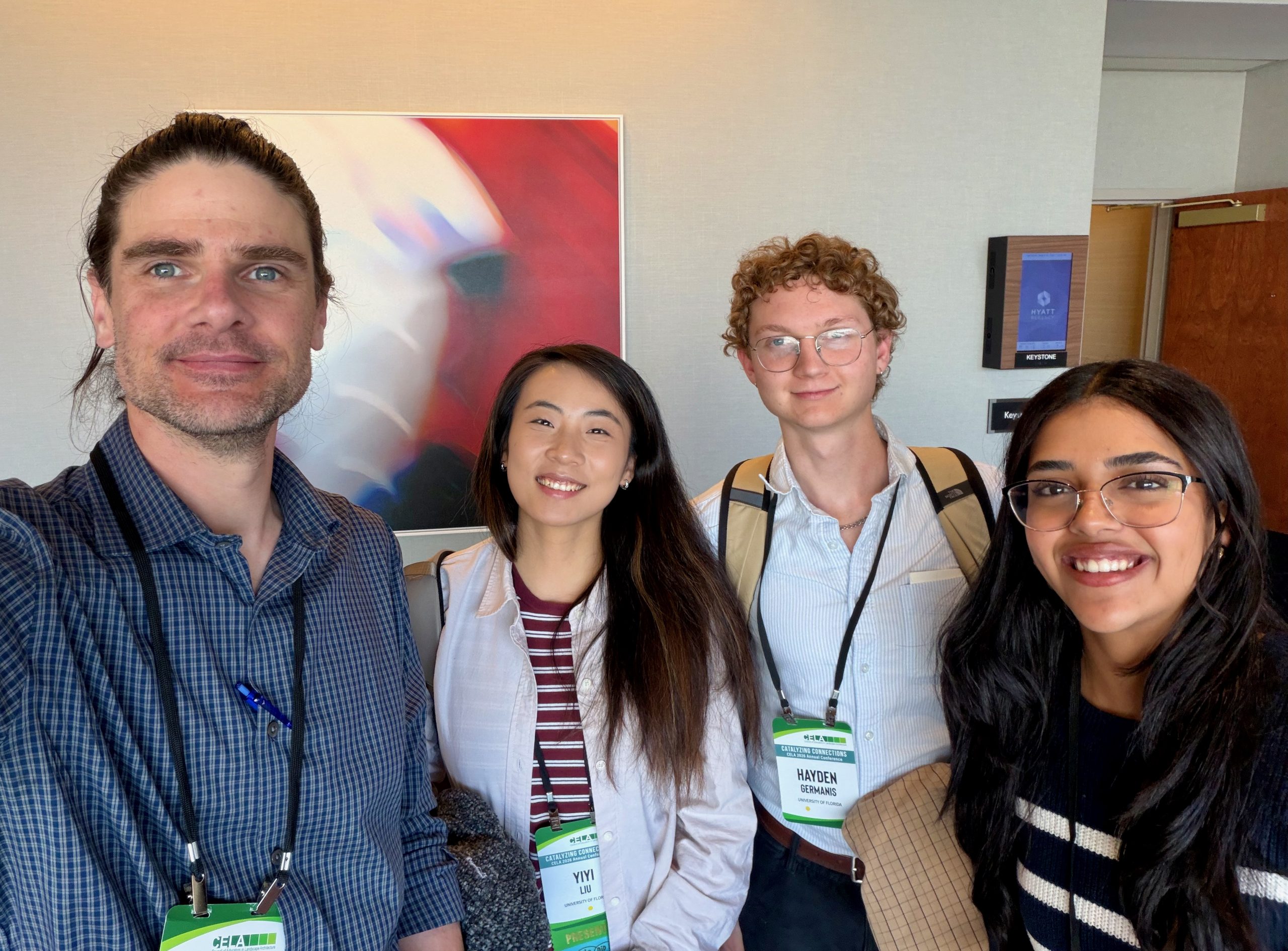 Left to right: Assistant Professor Nicholas Serrano, Ph.D. student Yiyi Liu, BLA student Hayden Germanis, and Architecture student Paola Diaz
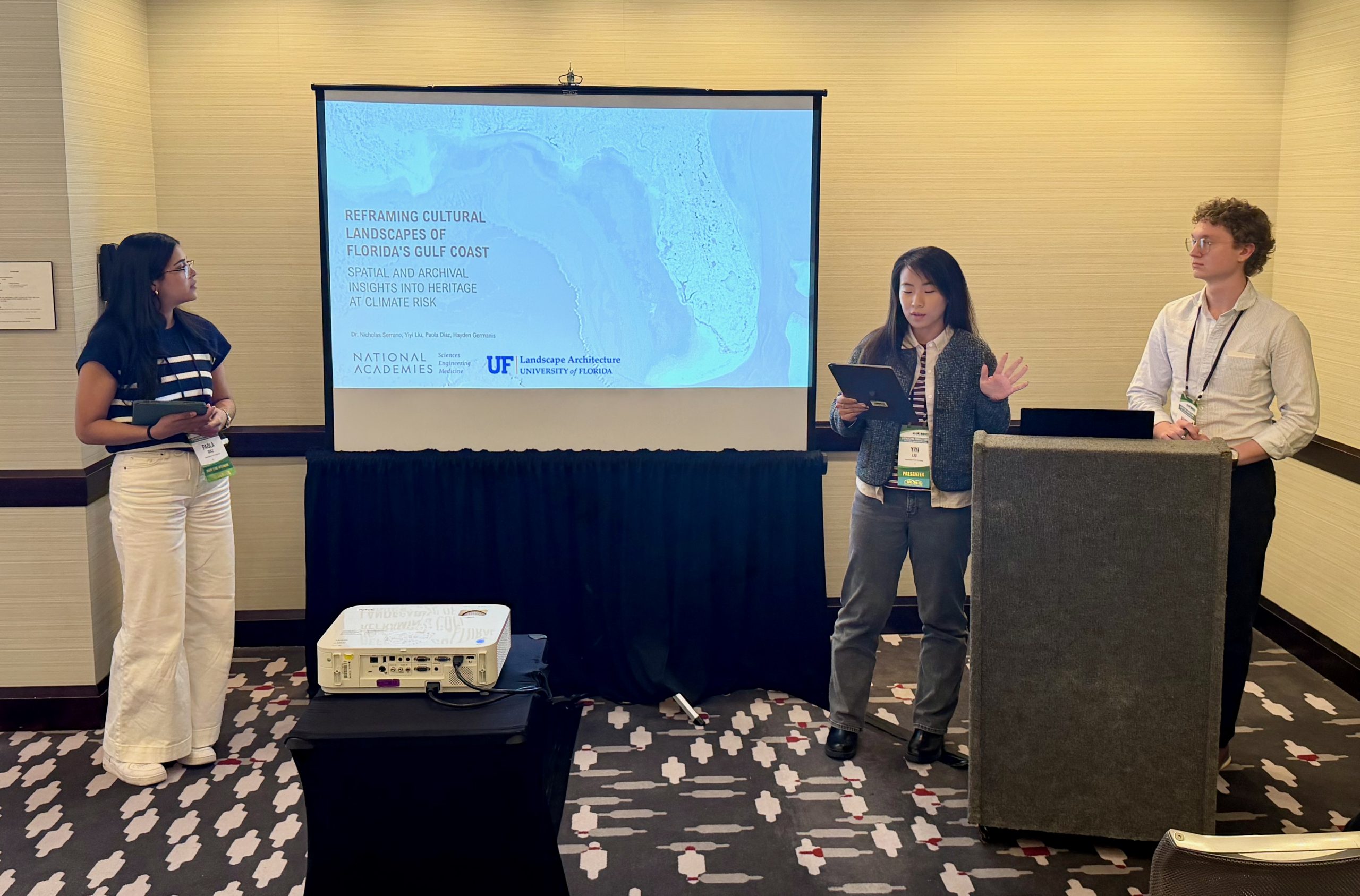 Left to right: Architecture student Paola Diaz, Ph.D. student Yiyi Liu, and BLA student Hayden Germanis
 Conclusion section of “Reframing Cultural Landscapes of Florida’s Gulf Coast: Spatial and Archival Insights Into Heritage at Climate Risk”
 Methods To Identify Hazard Exposure in “Reframing Cultural Landscapes of Florida’s Gulf Coast: Spatial and Archival Insights Into Heritage at Climate Risk”
This presentation centered around the town of Cedar Key, Florida, where an interdisciplinary team of students and faculty conducted research on the importance of cultural landscapes, in this case focusing on moving from isolated site documentation to a landscape-scale assessment of coastal hazard exposure. The project focused heavily on ancient shell mounds, which are man-made structures built by indigenous peoples throughout the Gulf South.
“The Shared DNA of the Landscape Foundational Studio”
Assistant Professor Andrea Galinski | Assistant Professor Jiayang Li
 Left to right: Assistant Professor Andrea Galinski, Assistant Professor Taylor D. Metz from Ball State University, Assistant Professor Yujia Wang from University of Nebraska-Lincoln, and Assistant Professor Jiayang Li
Joined by fellow faculty from the University of Nebraska-Lincoln and Ball State University, the panel examined the “shared DNA” of foundational landscape architecture studios. Drawing from the first two studios in UF’s Landscape Architecture program, Galinski shared teaching approaches centered around hands-on exploration and iterative making, while Li presented early findings from a national survey on how studios are structured across various BLA programs. Together, the panel clarified what landscape architecture educators collectively value in foundational studio instruction, while highlighting the diverse pedagogical approaches used across different institutions. Our faculty participated in the panel alongside:
Taylor Metz | Assistant Professor, Ball State University
Yujia Wang | Assistant Professor of Practice, University of Nebraska-Lincoln
“What role can landscape architecture play in decarbonization and how do local design decisions scale up to global impact?”
Dr. Jules Bruck | Chair, UF Department of Landscape Architecture
Dr. Jules Bruck presented as part of a panel on advancing landscape architecture in decarbonization and climate action alongside collaborators from both academia and practice. The presentation sparked conversation about carbon accounting, sequestration strategies, and how local actions can contribute to global solutions. Dr. Bruck participated in the panel alongside:
Boqian Xu | Assistant Professor, Texas A&M University College of Architecture
Chris Landau | Founder & Principal – Landau Design + Technology
Nicholas Pevzner | Assistant Professor, Weitzman School of Design, University of Pennsylvania
“What if zoos were understood not just as enclosures, but as productive and performative landscapes?“
Assistant Professor Yi Luo
This presentation focused on a collaborative study examining how zoos function as landscape matrices. Luo conducted this research alongside Alexander Green (BLA ‘21), who currently serves as a Landscape Architecture Analyst with the design firm Kimley-Horn. The project highlighted often-overlooked benefits of zoos such as food production, biomass generation, and climate and stormwater regulation. The study emphasized opportunities, proposed actionable strategies for enhancing zoo landscape design, and outlined metrics and methodologies for assessing their performance.
“Design with Data“
Assistant Professor Yi Luo
 Left to right: Assistant Professor Anthony Fettes from the University of New Mexico, Assistant Professor Yi Luo, Kirby Barrett from Kansas State University, and Jessica Canfield from Kansas State University
This presentation focused on pedagogical strategies for preparing students for professional practice where data-driven, evidence-based design approaches are increasingly the norm. Luo was joined on the panel by:
Jessica Canfield | Associate Professor, College of Architecture, Planning & Design, Kansas State University.
Kirby Barrett | Assistant Professor, College of Architecture, Planning & Design, Kansas State University
Anthony Fettes | Assistant Professor, School of Architecture + Planning, University of New Mexico.
“How do different people actually experience the same street, and how can we design for those differences?“
Postdoctoral Researcher Cenqi Zhu
 Cenqi Zhu presents her research on “Complete Streets”
Cenqi Zhu presented research on perception-driven street design through a Bayesian framework for evaluating “Complete Streets”, an approach to planning and design that maintains safe street access for all, including motor vehicles, public transportation, pedestrians, and cyclists of all ages and abilities. This study addressed current research gaps by developing a perception-centered evaluation framework that integrates diverse user perceptions and the combined effects of design features, including the levels of design elements, street design qualities, urban qualities, feelings, and satisfaction. This study advances street design by differentiating perceptual responses across user groups and introduces a machine learning approach that enables broader population-based predictions from limited survey samples.
“Streetscape Composition and Mental Distress in Aging Communities Across the Tampa Bay Metropolitan Area, Florida“
Ph.D. student Rui Hu
Rui Hu presented her study “Streetscape Composition and Mental Distress in Aging Communities Across the Tampa Bay Metropolitan Area, Florida” as part of the conference’s Landscape Architecture for Health session. The study addresses an important gap in understanding how eye-level streetscape composition may influence mental distress in communities with high concentrations of older adults. At a time when aging and mental health are emerging as critical public health concerns, the research highlights the role of everyday streetscapes in shaping well-being among older adults. The findings suggest that the relationship between streetscape composition and mental distress is shaped by threshold effects and socioeconomic context, underscoring the need for more balanced and equity-informed design strategies for aging populations.
“Pedagogies of Visualization: Lessons from New York City’s Bronx River Dam Removal Project“
Instructional Assistant Professor Aishwarya Shankar
Aishwarya Shankar highlighted how her Design Communication course immerses students in the real‑world task of visualizing ecological restoration for active dam removal sites. By collaborating with New York City Parks, the New York State Water Resources Institute, New York State Department of Environmental Conservation, and other stakeholders, students synthesized fish‑passage strategies, engineering recommendations, and community use scenarios into clear, compelling visual narratives using cartography, parametric modeling, an Em River Table, and AI tools. The interdisciplinary course re-examined the role of Design Communications courses in a typical landscape architecture curriculum. The course also proved that robust design communication can translate complex technical data into accessible stories, clarify trade‑offs, and foster democratic co‑design. The presentation sparked lively audience questions, a cross‑disciplinary panel discussion, and insightful conclusions about the power of visualization to bridge theory and practice.
