
PINE ISLAND & MATLACHA
Regional Assessment and Resilience Study
The Pine Island and Matlacha Regional Assessment and Resilience Study provides an overview of key vulnerability conditions across the area, based on community insights and spatial analysis. Using a vulnerability–capacity lens, it highlights interconnected challenges related to housing, infrastructure, access, and environmental risks, informing priority areas for targeted resilience interventions and the development of a regional resilience hub network.

Existing Conditions Overview
The following section analyzes Pine Island’s current conditions, focusing on its physical, demographic, and economic characteristics to provide a clearer understanding of the area’s existing context.
Environmental Vulnerability Maps
Coastal Flooding
Coastal flooding is a a major and ongoing challenge in Pine Island and Matlacha, driven by both environmental conditions and changing climate patterns. Low elevation and flat terrain significantly increase flood risk, while rising sea levels and high tides already inundate roads and homes. The loss of mangroves and wetlands reduces natural protection, while pollution and saltwater intrusion degrade ecosystems. These changes contribute to habitat loss, affecting farming, water quality, and coastal environmental conditions.

Hurricane & Storm Surge Impacts
Hurricanes and storm surge events pose significant and recurring risks to Pine Island and Matlacha, shaping both immediate damage and long-term vulnerability. During major storms, storm surge can rapidly overtop the islands, leading to widespread flooding. Limited natural protection further increases exposure to severe impacts, while repeated hurricanes and rising sea levels continue to intensify future risks. These conditions reinforce the urgent need for stronger resilience strategies and more effective recovery planning across both communities.

Transportation Map
Pine Island’s single access road and lack of public transit leave the community highly vulnerable, a weakness made clear during Hurricane Ian. This highlights the need for more resilient transportation options.
Main Challenges:
Single Access Route: Pine Island Road is the only mainland connection and remains flood-prone.
Storm Impacts: Bridges and road sections were destroyed during Ian, revealing structural fragility.
Limited Transit: Few public transport options; residents rely on nonprofits for essential trips.
Accessibility Issues: Low elevation and poor pedestrian infrastructure limit mobility.
Evacuation Risks: Growing traffic and development may worsen evacuation challenges.

Affordable Housing Map
Affordable housing challenges remain a critical concern in Pine Island and Matlacha, particularly in the aftermath of Hurricane Ian. The storm intensified an already limited housing supply, while high rebuilding costs, stricter building codes, and rising prices continue to slow recovery efforts. Low-income families and farmworkers are among the most affected, with many homes still damaged or uninhabitable. As a result, some residents continue to rely on temporary shelters, underscoring the urgent need for more affordable and resilient housing solutions.


Food System Map
Food system vulnerabilities in Pine Island and Matlacha reflect both local access challenges and broader environmental pressures. While Pine Island supplies much of Lee County’s tropical fruit, a large portion is distributed off-island, limiting local availability. At the same time, limited supermarkets and transportation options restrict access to food, especially for vulnerable populations. These challenges become more critical during emergencies, when food insecurity increases. Additionally, local farms face growing risks from saltwater intrusion, rising temperatures, and stronger storms, threatening both crop production and the livelihoods that depend on them.

Priority Area Zones
Priority area zones in Pine Island and Matlacha are identified through an integrated spatial analysis that combines the Hazard Exposure, Sensitivity, and Adaptive Capacity (HESAC) model and the Vulnerability–Resilience Indicator Model (VRIM). These models assess both physical hazard exposure and community-level vulnerability, including environmental, infrastructure, and socio-economic conditions.


The analysis identified several priority areas across Pine Island and Matlacha where high social vulnerability overlaps with significant flood risk, highlighting the need for targeted resilience interventions. Key locations include Matlacha, Pine Island Central as a critical service hub, and Northern Pine Island (the Ridge) as a strategic, higher-elevation area for support and resource distribution.
Community-Informed Vulnerability and Resilience Systems (Based on Community Engagement)
This diagram illustrates how interconnected systems—such as housing, infrastructure, access to services, and environmental risks—collectively shape vulnerability and resilience across Pine Island and Matlacha. Informed by community insights and spatial analysis, it shows how these factors interact through a vulnerability–capacity lens to influence daily life and recovery. These insights help identify priority needs and guide targeted resilience interventions, including the development of a regional resilience hub network.

Community Statements from Pine Island and Matlacha
The community shows strong resilience, with residents supporting one another during and after storms. Local organizations and volunteer initiatives, such as Beacon of Hope and the Greater Pine Island Alliance, play a vital role in disaster response and recovery, showing a strong culture of collaboration. The map shows statements from community members, sharing lived experiences, everyday challenges, and local strengths across Pine Island and Matlacha. These insights help inform strategies for community and emergency response infrastructure, as well as resilient spatial development, to support long-term climate resilience.


Resilience Strategy
The Resilience Strategy outlines key components and processes to strengthen social and infrastructure resilience in Pine Island and Matlacha in response to climate hazards. Grounded in community strengths such as mutual aid and local organizing, it supports long-term adaptation by addressing interconnected social, economic, and environmental challenges.
Three Priority Locations
The spatial and social vulnerability analysis identified three key areas: Center Pine Island, Northern Pine Island, and Matlacha. These zones contain the highest concentration of residents, essential services, small businesses, and food systems, while also experiencing the most significant access challenges, particularly during emergencies. In contrast, the southern area is not included, as its vulnerability levels and service needs are relatively lower compared to the three priority zones.
Located on county-owned land in Pine Island Center, near the library and park, this site serves as the island’s primary emergency and community hub. It provides essential gathering space, social services, and support for nonprofits and community groups, while being designed to enhance accessibility and flood resilience for surrounding residents.

Located along the main road in the higher-elevation Ridge area near Fruitscapes, this site supports the agricultural community and farmworkers in the northern part of the island. It provides services such as housing assistance, food distribution, childcare, and workforce preparedness, while ensuring accessible support and protection both before and after disaster events.

Located at the former Civic Association building within the county park, this site serves as a key hub for supporting local businesses, artists, and community connections in Matlacha. It functions as the main emergency operations center, improving coordination, accessibility, and overall resilience in a highly flood-prone area.

Resilience Hubs Regional Network
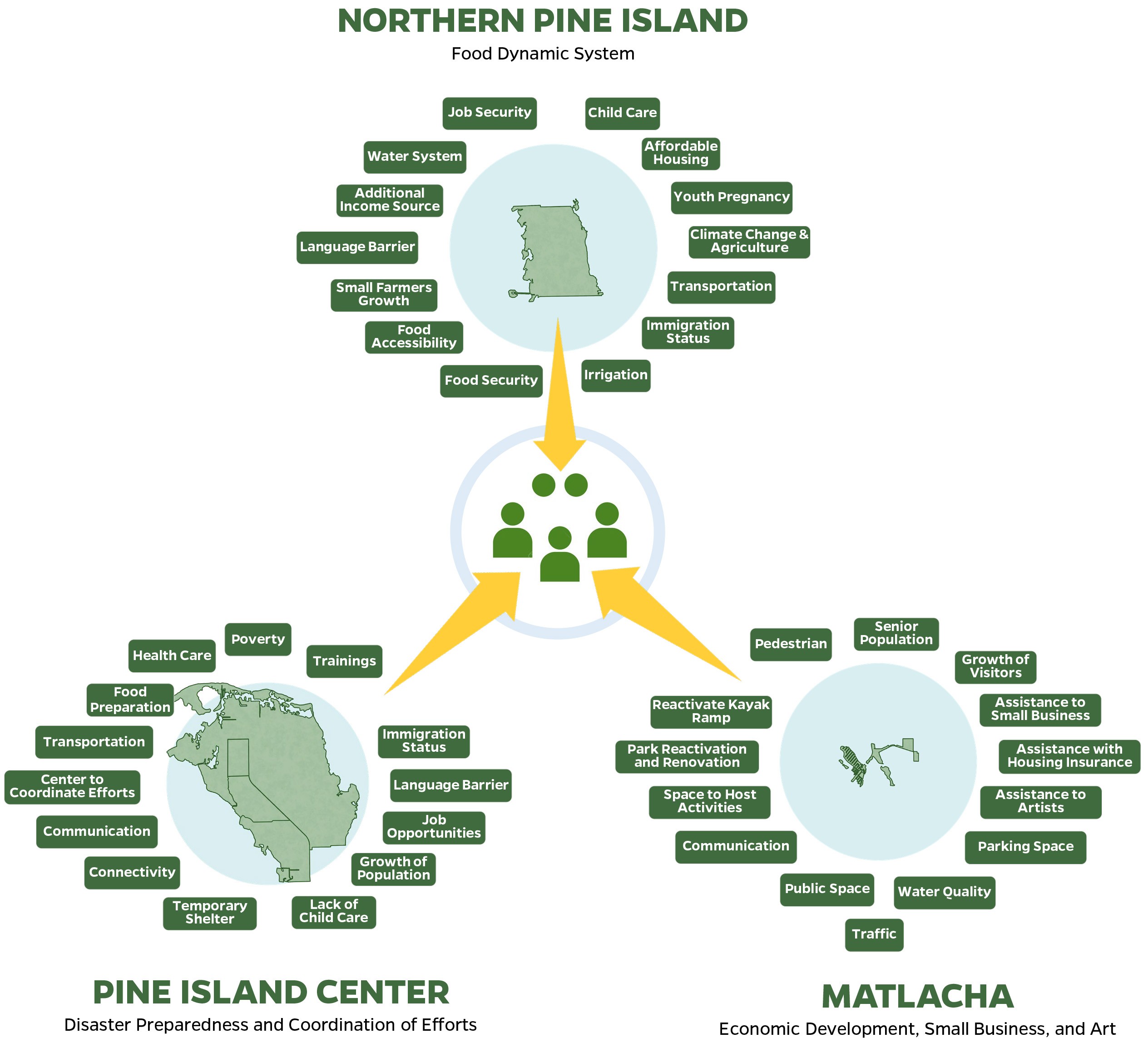
The Resilience Hubs Regional Network establishes a framework for multi-purpose community facilities that support daily needs and function as emergency response centers during disasters. Based on stakeholder input, three priority locations are identified to improve access to essential services such as healthcare, education, social support, and emergency logistics. Operating under a “blue/gray sky” model, these hubs provide regular community services in stable times and shift into coordinated response centers during disruptions, supporting flexible, dual-use spaces that address key community needs such as shelter, food access, and communication.
Common words used by the community at each geographic location to highlight their perceived needs and priorities for enhancing resilience

Resilience Hubs Operational Framework
Resilience Hubs are trusted community-centered facilities that offer essential services in daily life and shift into coordination centers during emergencies. They strengthen local support systems, improve resource access, and enhance preparedness in vulnerable areas.

Resilience hubs serve communities in three operating conditions:

The Resilience Hub is a central resource supporting communities in their daily needs, such as healthcare, education, and social services. Its immediate purpose is to reduce social vulnerability among at-risk groups. The key role of the Hub is also to strengthen disaster preparedness by coordinating with trusted local partners, sharing information, and reinforcing social ties before disruption occurs.

During disruption, the Resilience Hub functions as a centralized site for emergency response, distributing essential supplies, sharing reliable information, and coordinating local actions. The integrated model enables residents, organizations, and emergency responders to work together, ensuring that critical resources are delivered efficiently across the community. The hub also operates in coordination with other Resilience Hubs as a network, allowing for mutual support, information exchange, and efficient response efforts across the region.

In the recovery phase, Resilience Hubs serve as central coordination points that provide access to urgent relief and sustained support. They organize the distribution of resources, facilitate communication, and create a collaborative space for agencies, volunteers, and community partners. By anchoring services in a trusted location, hubs connect residents to recovery programs, help assess evolving needs, and guide the rebuilding process with consistency and local knowledge.
Potential partnerships for the operations of the three Resilience Hubs and the possible operational models


Collaborative Network
Resilience hubs rely on strong partnerships between community organizations and government agencies to ensure long-term service, trust, and effective response. Through ongoing engagement and inclusive outreach, local partners—such as schools, nonprofits, and groups like the Beacon of Hope—help integrate the hub into everyday community life.
Together, these hubs operate as a collaborative network, where each location provides complementary services that support one another. This connected system creates an integrated network of social services, disaster preparedness, and recovery support across Pine Island and Matlacha.

Project Outcomes & Reports
The two outcomes include the Pine Island and Matlacha Resilience Study Report and the Resilience Hub Design Studio Project. The study report provides analysis and planning recommendations for recovery and long-term resilience. The design studio project, developed by the University of Florida School of Architecture, explores the application of resilience hub concepts at the building scale. These student-led proposals are conceptual and not built, serving as exploratory studies to inform future resilience efforts.
Pine Island and Matlacha Resilience Study Report

Resilience Hub Design Studio Report
UF School of Architecture
