
Written by Molly Freeburg
GAINESVILLE, Fla. — Gatorcorps, at its core, unites sixteen service members across four locations around a vision for resilience in Florida. With each member comes a different journey– a unique path in discovering their identity in GatorCorps and becoming a vital member of the organization. For Amaya Borroto, a student at the University of Florida double-majoring in Political Science and Sustainability and the Built Environment, her journey with GatorCorps started when the organization collaborated with the University of Florida’s Gulf Scholars Program.
In November 2024, GatorCorps teamed up with Gulf Scholars to take students from the University of Florida to the Florida Museum of Natural History’s’s Randell Research Center, located in Pineland, Florida, in efforts to assist in hurricane recovery and community resilience. Pineland is a Calusa cultural heritage site and estuarine ecological preserve. Open to the public year-round and committed to community education, the site preserves 2,000 years of Calusa history and includes the remnants of large shell mounds and an ancient canal system. It is also home to a diversity of animals, plants and estuarine habitats unique to southwest Florida.
In the aftermath of Hurricanes Ian, Milton, and Helene, parts of Pineland had been damaged or destroyed. Through this joint effort, students from both GatorCorps and the Gulf Scholars Program answered the call to restore these sites while preserving the history and resilience of Southwest Florida’s coastal communities.
Participating originally through the Gulf Scholars Program, Amaya explained that the significance behind preserving this archaeological site was linked to over 1500 years of Indigenous history, as well as more recent coastal history and communities living on Pine Island. The site is a community resource for people on Pine Island and across southwest Florida.
“Learning about the Calusa on that first trip, I felt like I was participating in a history with deep roots, working over generations to design safe, sustainable environments for communities,” said Borroto.
A key component of the Calusa communities were their uniquely designed, extensive shell mounds. According to the Florida Museum of Natural History, these mounds “served as village foundations and defensive structures”, with some extending over thirty feet above the ground. Although many Calusa mounds were later reduced or destroyed by development of the southwest coast, today those that remain are known to often support diverse plant life, including native and endemic plant species, Amaya learned that over time and especially throughout the course of several active hurricane season, invasive plants had spread over the mounds at Pineland, threatening native and endemic plant communities, and in some cases damaging archaeological contexts.
In efforts to protect the historical significance of the Pineland mounds and plant life while supporting their continued use as an educational community resource, Borroto and fellow students from both GatorCorps and the Gulf Scholars Program worked to remove several invasive plant species that had taken over Brown’s Mound. This mound is one of many created by the Calusa tribe that still stand in Pineland today. When reflecting on her experience, Amaya stated that this first-hand experience inspired her to pursue further involvement in community resilience efforts, leading her to officially join GatorCorps.
GatorCorps, a core program at the Florida Institute for Built Environment Resilience (FIBER), enhances local disaster risk reduction efforts, promotes urban adaptation and works with partners towards resilient communities. Members serve at 4 locations across North Florida. As a member serving at FIBER, Amaya’s previous work through the Gulf Scholars Program came full circle when returning to Pineland, this time through GatorCorps, for a new project.
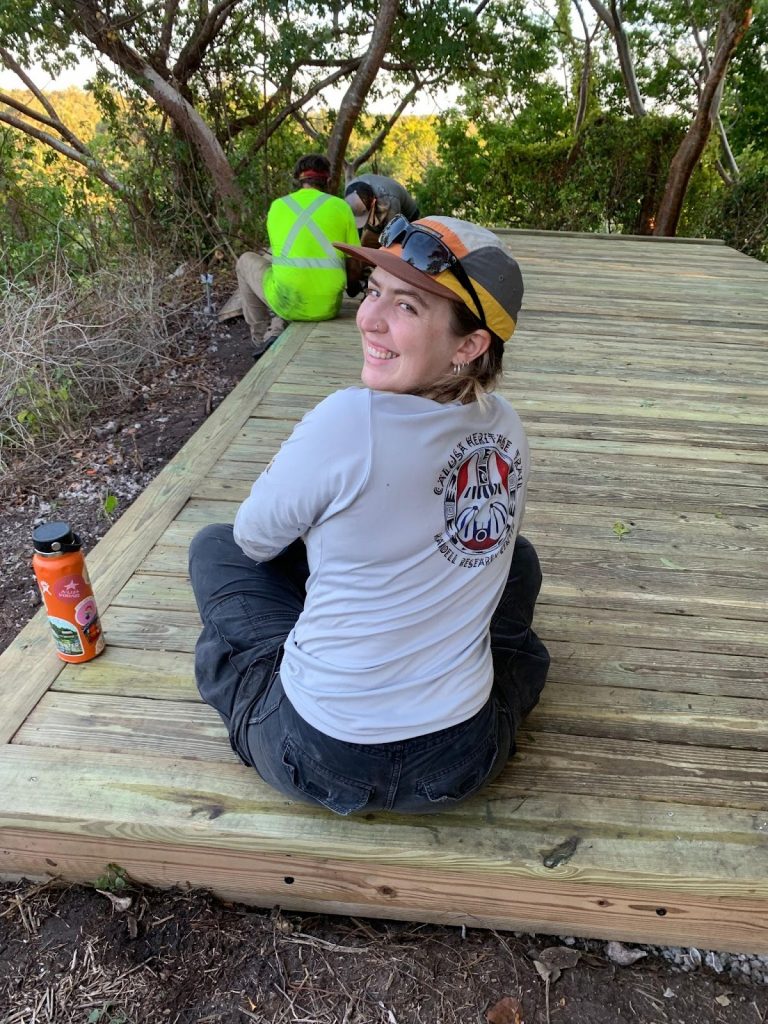
Florida Museum photo by Michelle LeFebvre
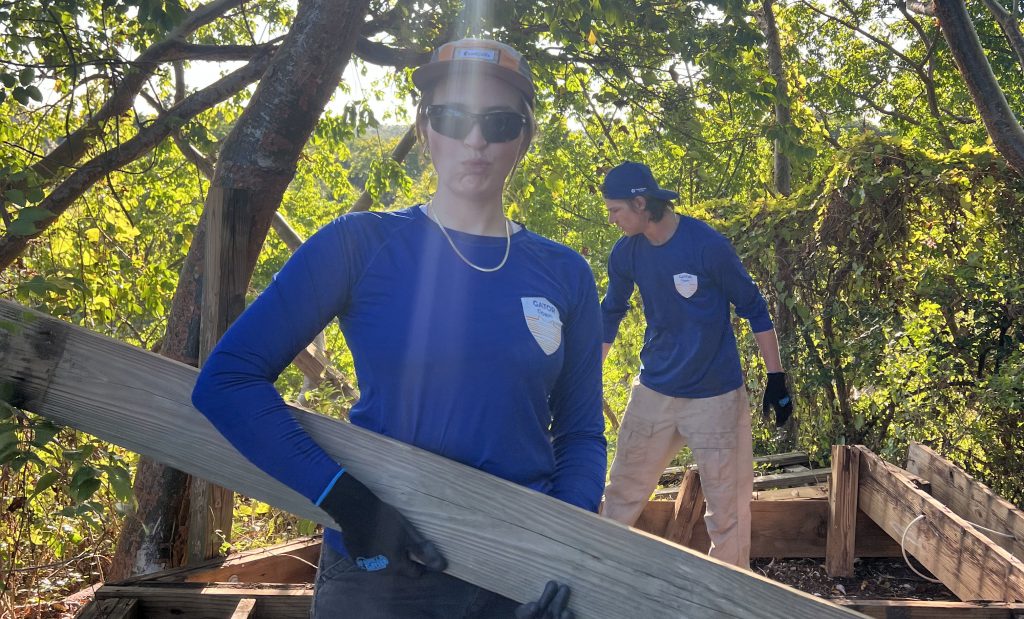
This past December, a GatorCorps team revisited the Randell Research Center to rebuild the Brown’s Mound observation platform. Once serving as a favorite place for school field trips and site tours, the platform was destroyed by Hurricane Ian over three years ago. Completed in just a week, Amaya and the GatorCorps team worked to clear old structural debris, and reconstruct the platform without disturbing or damaging the archaeological surface of the mound. “This project,” Amaya expressed, “was an embodiment of being able to construct historical spaces while being considerate of resources being used”. Every step of the project, from the materials used to the planning of the construction process, kept in mind the archaeological integrity of the mound, the preservation of Calusa artifacts, and the conservation of the plant resources the observation platform was constructed upon.
“During the deck construction, we used fill purchased from a lot to level the site without damaging the archaeological record beneath us,” said Amaya. “I noticed several pieces of shell in the gravel we were using and I was struck by the continuity in building materials from the days of the Calusa to our project- shells upon shells.”
From protecting ancient shell mounds to building a destination for the public to appreciate cultural heritage, Amaya Borroto has come full circle. What began as a field trip with the Gulf Scholars Program evolved as a lasting dedication to community resilience, now carried forward through GatorCorps in current and upcoming projects.
Reflecting on her experience, Amaya contributes much of what she learned throughout the two organizations to what she dreams to accomplish in the future. “Gulf Scholars and GatorCorps have both shaped my passion to support safe, sustainable development in Florida’s vulnerable cities as a designer and a planner.”
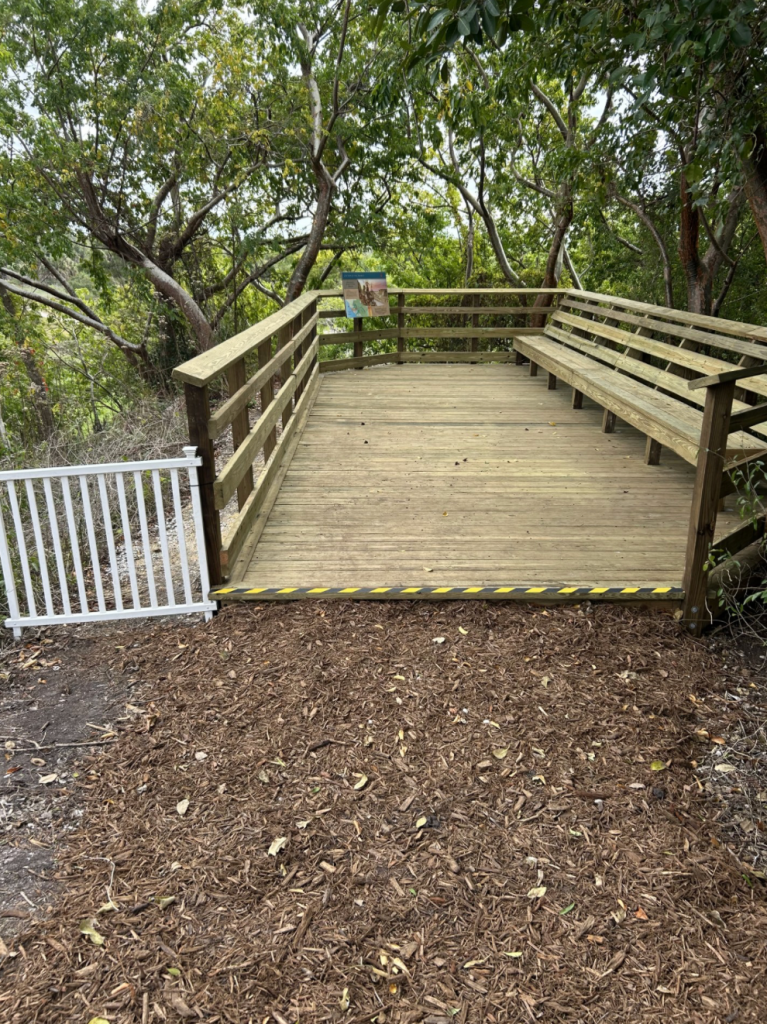
Florida Museum photo by Natalie Binder