
Advanced Urban Mobility
We study emerging transportation systems—including microtransit, micromobility, electrification, ridesourcing, public transit, and autonomous vehicles—and their effects on travel behavior, accessibility, and urban development. We also use AI-driven methods to evaluate the performance and resilience of mobility systems under climate hazards.

Concept of Advanced Urban Mobility
Advanced Urban Mobility covers the study of emerging and evolving transportation systems, including microtransit, micromobility, ridesourcing, public transit, and autonomous vehicles, and how they shape travel behavior, accessibility, and urban development.
This is an active and fast-changing research area. As cities adopt ride-hailing, shared scooters and bikes, and autonomous shuttle pilots, researchers are increasingly combining big data, GIS, and AI-driven methods to understand how these services interact with the built environment and how well transportation networks hold up under stress, including climate hazards.
Key Questions We Aim to Answer
How do land use and the built environment shape demand for ride sourcing, taxis, and other mobility services?
How can AI-driven methods improve the prediction, planning, and resilience of urban mobility systems?
How can microtransit and micromobility systems, including e-scooters and autonomous shuttles, be deployed effectively and equitably across different neighborhoods?
How resilient are transportation networks, including multimodal and rail transit systems, to climate hazards such as sea-level rise and extreme weather?
Featured Research & Projects
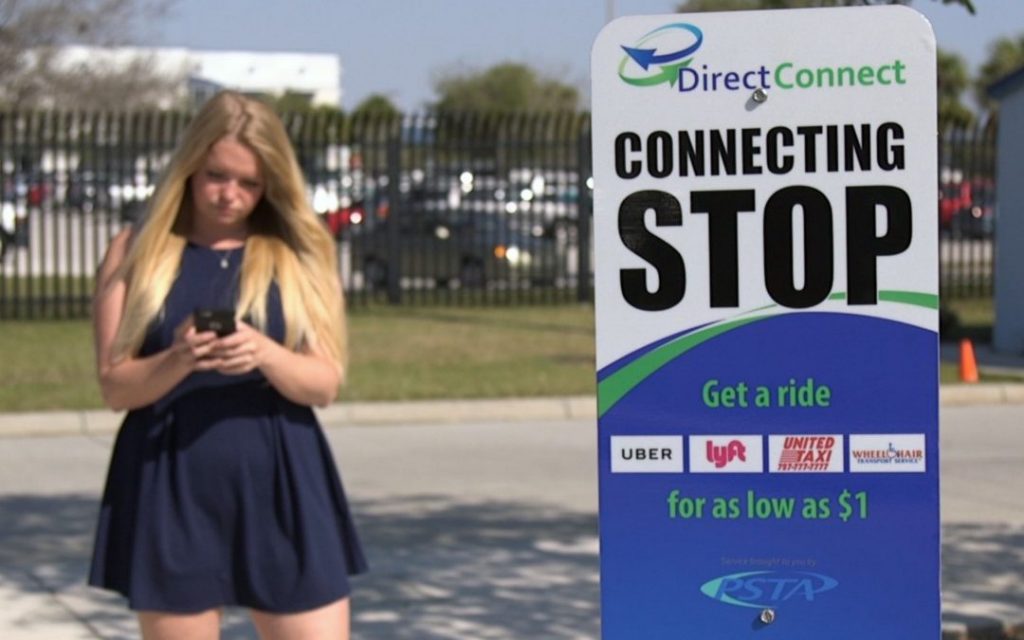
Evaluating the connection between transit and TNCs (Transportation Network Companies) in Pinellas County for statewide application

Evaluating the effectiveness and funding mechanism of the Downtowner service in Tampa, Florida for statewide application

Examining Data Needs and Implementation Process of AV-based Microtransit Service: A Case Study in Lake Nona
Selected Publications
Lu, K. F., Liu, Y., Peng, Z. R., & Zhai, W. (2026). Characterizing performance resilience of transportation networks against hurricane events. Applied Geography, 186, 103820.
Liu, Y., Lu, K., Peng, Z.-R., & Zhai, W. (2024). Autonomous shuttle acceptance in an American suburban context: A revealed preference study in Lake Nona, Florida. Travel Behaviour and Society, 37, 100865. https://doi.org/10.1016/j.tbs.2024.100865
Lu, K. F., Liu, Y., & Peng, Z. R. (2025). Unraveling urban bike-sharing dynamics: Spatiotemporal imbalances in bike rentals and returns in Washington DC. Cities, 162, 105967.
Yu, H., & Peng, Z.-R. (2019). Exploring the spatial variation of ridesourcing demand and its relationship to built environment and socioeconomic factors with the geographically weighted Poisson regression. Journal of Transport Geography, 75, 147–163. https://doi.org/10.1016/j.jtrangeo.2019.01.004