Human-AI Collaboration in Transit Network Design
A Data-Driven Planning Case from Tampa
As artificial intelligence increasingly shapes how cities are planned and managed, a key question for planners is whether AI can move beyond supporting analysis to actually generating spatial plans. This study explores that question in the context of public transit network design, using downtown Tampa, Florida as an empirical testbed.
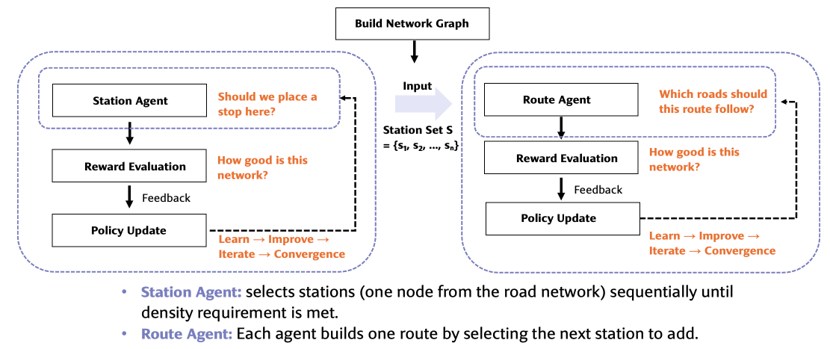
We develop a hierarchical deep reinforcement learning framework that generates complete fixed-route bus networks directly from observed travel demand data. The data comes from Tampa’s Downtowner, a free on-demand micro-transit shuttle service operating in downtown Tampa, which provides detailed origin-destination trip records reflecting how residents actually move through the city. Rather than relying on historical service patterns or manual design, the framework learns from this real-world mobility data to identify where stations should be placed and how routes should connect them.
The framework operates in two sequential layers. The first layer identifies candidate station locations by detecting high-demand anchor points from observed travel patterns, while balancing spatial coverage and regional equity across the study area. The second layer designs routes connecting those stations, satisfying travel demand while respecting road network constraints and route geometry requirements. Planners define the objectives and constraints, and the model generates multiple complete network scenarios under different budget and infrastructure conditions, allowing planners to compare trade-offs across configurations.
The results show that the AI-generated networks substantially outperform Tampa’s existing transit system in service coverage, direct connectivity, and cost per passenger served. More importantly, the study finds that AI-generated designs still require planner refinement before they are ready for implementation, particularly in addressing geometric weaknesses and local operational constraints that the model alone cannot resolve.
The Tampa case provides concrete evidence of what human-AI collaboration in transit planning looks like in practice: AI handles the generative and computational work, producing demand-responsive network proposals at a scale and speed that manual design cannot match, while planners provide the contextual judgment needed to translate those proposals into implementable plans. Neither alone produces the result that both together can achieve. The study is situated within a broader research agenda on the evolving role of AI in urban planning, examining how planning practice can advance from AI-assisted analysis toward AI-generated plan-making while keeping planners in a meaningful supervisory and refinement role. The findings offer practical guidance for transit agencies exploring data-driven network redesign, and contribute empirical grounding to planning theory on human-AI collaboration.